Impact

By investigating and exposing human rights abuses, we work to create a world where everyone is treated fairly and equitably, no matter their race, religion, or beliefs. We call for action so that people who disagree with their government can speak their opinions freely, so that children are protected, and refugees cared for. All of us, regardless of who we are, who we love, or the color of our skin, should be able to enjoy fully our human rights.

BROWSE ALL IMPACT ›

Change is sometimes immediate, sometimes incremental. We work on issues for years and know from experience how to transform deep-rooted problems. Here are examples of some of the recent impact we have made, together with our partners, in advancing human rights around the world.

How do we bring about change?

Investigate
Our researchers investigate human rights abuses, first by speaking with victims or witnesses. We corroborate their stories using a variety of sources, including government records, weapons’ fragments, satellite imagery, and the statements of accused perpetrators – be they members of governments, armed groups, or companies. We often do this work together with partner activists.

Expose
We share this information widely, in multiple languages, to help shape public debate. Our reports, videos, and social media posts show up hundreds of times daily in news media around the world, bringing both global and local attention to our rigorously fact-checked findings.

Change
Often in coalition with local groups, we bring our findings to officials who have the power to change things. For every issue we work on, we make specific, concrete policy recommendations that will bring people justice, prevent future abuses, and protect human rights.

Our work has been instrumental in some foundational victories for human rights, including our work on banning landmines worldwide, for which we and our partners received the 1997 Nobel Peace Prize. Below are some examples of our historic impact.

All impact

  • January 18, 2018
    Qatar announced a range of significant human rights reforms during 2017 that if carried out would usher in some of the most progressive human rights standards in the gulf region, Human Rights Watch said today in its World Report 2018.
    People look at a model of Al Thumama stadium during an unveiling ceremony at Hamad International Airport in Doha, Qatar, August 24, 2017. © 2017 REUTERS/Naseem Zeitoon
  • November 15, 2017
    Working on child labor, it often feels like there isn’t much good news. So when I learned recently about a new policy that could potentially protect millions of children from dangerous work on tobacco farms around the world, I couldn’t quite believe it.
  • November 8, 2017
    A new position statement by the North American Society for Pediatric and Adolescent Gynecology represents a significant step toward ending medically unnecessary surgery on intersex children who are too young to consent, Human Rights Watch and interACT Advocates for Intersex Youth said today.
    Turks Head Surgery Center, where urologist Dr. Ilene Wong spoke to Human Rights Watch about shortcomings in providing care to patients with differences in sex development (DSD) and their families.
  • November 3, 2017
    The Mali Defense Ministry’s stated commitment to investigate serious alleged abuses by the security forces during operations in central Mali is a meaningful step toward accountability, Human Rights Watch said today.
    A Malian soldier during a military operation in northern Mali, October 19, 2017.
  • October 17, 2017
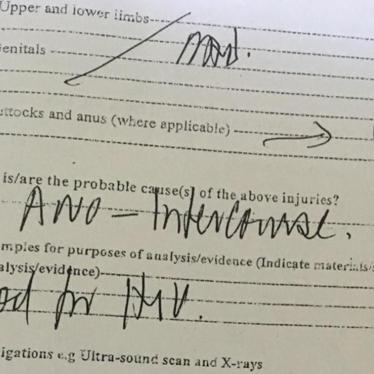
    Doctors, medical professionals, and national medical associations should heed the World Medical Association’s October 2017 resolution to end forced anal examinations on people accused of homosexual conduct, Human Rights Watch said today.
    A medical report filled out by a doctor in Kampala, Uganda, after conducting a forced anal examination on a man suspected of consensual same-sex conduct.
  • October 17, 2017
    The Constitutional Court’s decision on October 5, 2017 to strike down Kuwait’s overly broad DNA law is a positive step for the right to privacy in the country, Human Rights Watch and GeneWatch said today. The 2015 law had required all Kuwaiti citizens, residents, and visitors to provide DNA samples to authorities, in violation of their right to personal privacy. Kuwait was the only country to require nationwide compulsory DNA testing.
    A general view of the Kuwait Palace of Justice (court house) in Kuwait City, Kuwait.