Summary
The current regime is trying to subjugate every institution.
– SY Quraishi, former Chief Election Commissioner of India, November 2025
In June 2025, the Election Commission of India began a nationwide Special Intensive Revision (SIR) of electoral rolls, ostensibly to remove any dead, duplicate, or ineligible voters. By October 2026, it had deleted over 130 million names—disproportionately excluding women, people living in poverty, religious minorities, particularly Muslims, and other marginalized communities—in a deeply flawed, arbitrary, and opaque process.
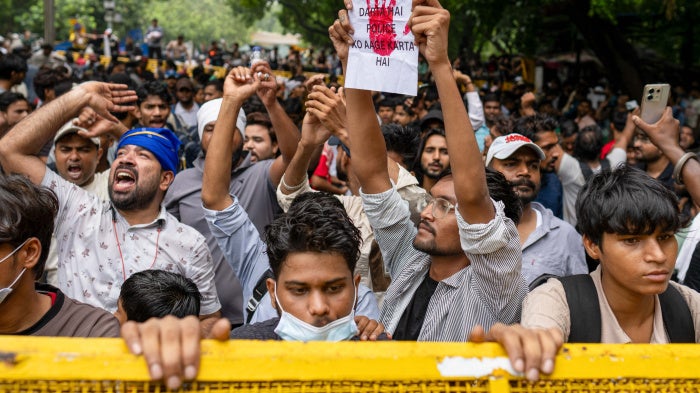
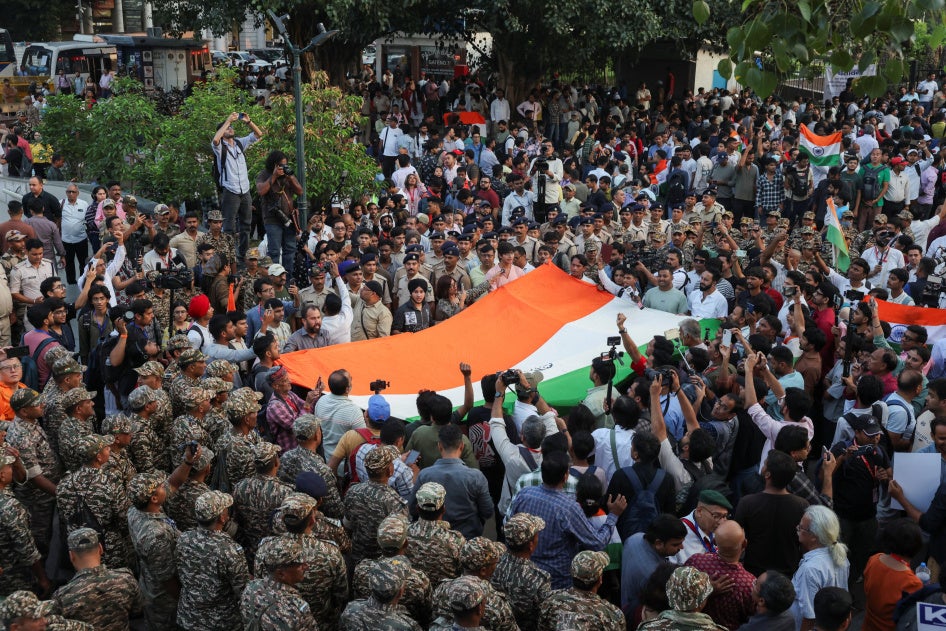
When protesters demanded that the SIR process be scrapped and that the country’s top election official resign, the administration of Prime Minister Narendra Modi responded with arbitrary restrictions on movement, suspension of mobile internet services, and deployment of over 40,000 security personnel in New Delhi, India’s capital, who used excessive force against protesters and arbitrarily detained thousands.
India’s judiciary did little to protect the rights of voters or protesters; ostensibly independent oversight bodies such as the National Human Rights Commission and the commissions to protect women, Dalits and tribal communities, and religious minorities largely stayed silent. In West Bengal state, where over nine million people—12 percent of the electorate—were removed from voter lists just ahead of state elections in April 2026, the Supreme Court effectively said it was acceptable for those excluded to wait for their next chance to vote if they succeeded in proving their claims.
The partisan conduct of the long-respected Election Commission, the Supreme Court’s failure to intervene despite evidence of disenfranchisement, the tepid response of national human rights institutions, and the Modi government’s censorship of critical online content while using broadcast television networks to frame the protests as “anti-national,” taken together tell a story of growing institutional crisis and weakening rule of law in India.
This report examines how the BJP government has been undermining human rights since taking office in 2014 through political interference in systems and institutions intended to protect the population. It examines developments under the Modi administration in four main areas: undermining parliamentary procedures and suppressing the opposition; weaponization of federal investigative agencies for political ends; weakening constitutional and statutory institutions such as the Election Commission, Central Information Commission, the anti-corruption ombudsman, and human rights commissions; and interfering in the judicial branch as well as the judiciary’s own failings in upholding civil liberties.
The weakening of these systems and institutions has enabled the government to harass its critics and normalize discrimination and violence against Muslims, Christians, and other religious minorities, and populations living on the margins or with poverty. The authorities have tightened restrictions on media freedom, civil society, and academic institutions, while bringing baseless criminal charges against human rights activists, peaceful protesters, independent journalists, academics, students, and political opponents.
Undermining Parliamentary Procedures
The BJP won its third consecutive term in office in June 2024. During its first two terms, from 2014 to 2024, the BJP enjoyed a full majority in the Lok Sabha (the lower house of parliament) and then disregarded parliamentary oversight mechanisms by bypassing parliamentary committees and violating procedures to impose its political agenda. It kept key opposition posts in parliament vacant for years, violating legal and constitutional provisions. It also miscategorized bills as “money bills” to avoid parliamentary scrutiny.
An analysis by civil society groups of the functioning of parliament during the first 10 years of the Modi administration found that the government “deliberately violated procedures and constitutional provisions to turn the parliament into an instrument for majoritarian and undemocratic law-making.”
The government also ignored the tradition of establishing parliamentary standing committees to scrutinize technical aspects of bills in consultation with experts and stakeholders. The New Delhi-based independent research organization PRS Legislative Research found that the government during its first term from 2014-2019 referred only 28 percent of bills to committees; during its second term from 2019-2024, that figure dropped to 16 percent. Both were far lower than the 71 percent and 60 percent of bills examined by committees under administrations in power from 2009-14 and 2004-09 respectively.
The BJP did not have a majority in the Rajya Sabha (the upper house of parliament) from 2014 to 2024. While all bills must be approved by both houses to become law, some regulating financial matters can under the constitution be introduced in the Lok Sabha as “money bills,” which do not require Rajya Sabha approval. The Modi administration has aggressively used money bills to push through laws with serious consequences for fundamental rights that would not qualify as money bills.
Supreme Court Judge D.Y. Chandrachud had noted that using money bills to legislate was an “abuse of the constitutional process.”
Weaponizing Federal Investigative Agencies
The Modi government has used federal investigative agencies to pursue political ends. These include the Central Bureau of Investigation (CBI), the premier federal agency for investigating serious crimes; the Enforcement Directorate, which investigates economic crimes; and the National Investigation Agency (NIA), which prosecutes counterterrorism cases.
Opponents and critics of the BJP have faced trumped-up allegations of corruption or financial irregularities. Federal investigative agencies have also targeted several prominent domestic and international rights groups, human rights lawyers, activists, and media organizations since 2014 under the Foreign Contribution (Regulation) Act and other laws dealing with financial irregularities.
National Investigation Agency
The NIA has used the abusive counterterrorism law, the Unlawful Activities (Prevention) Act (UAPA), to target human rights activists.
The case of GN Saibaba, a human rights defender who advocated for the rights of India’s marginalized Dalit and Adivasi communities, is emblematic of the failure of independent institutions to protect rights. In May 2014, authorities detained Saibaba, who had been wheelchair-bound since contracting polio as a child, along with five others under the UAPA, accusing them of having links to banned Maoist groups. In March 2017, a court in Maharashtra convicted him on fabricated terrorism charges largely based on literature he possessed that it deemed “anti-national” and sentenced him to life in prison. In 2022, the Supreme Court denied his plea for house arrest on medical grounds, despite evidence of serious deterioration in his health.
In March 2024, the Bombay High Court acquitted Saibaba on both procedural grounds and because the state had failed to make a credible case. Upon release, he said, “except for the polio that I’ve had since my childhood, I went to jail without any health issues. But today, … though alive, each and every organ [is] failing me.” In October 2024, Saibaba died during needed surgery, seven months after his release from prison.
The Modi administration in 2019 amended the UAPA under which Saibaba and others were arrested, already a vague and overbroad law, to empower the central government to designate individuals as “terrorists.” Several opposition leaders said the amendment would give the authorities even more powers to misuse a law already used to target activists and critics, and demanded the bill be sent to a parliamentary committee for greater scrutiny. However, the BJP government, with its parliamentary majority, pushed the law through.
The NIA’s misuse of the UAPA for indefinite detention has had deadly outcomes. One of Saibaba’s co-accused, Pandu Narote, a 33-year-old Adivasi man, died in custody from swine flu in 2022 after being denied proper treatment. Stan Swamy, an 84-year-old Jesuit priest with Parkinson’s disease who was a prominent advocate for Dalit and Adivasi rights, died in custody in 2021 after being arrested with 15 other human rights defenders in the politically motivated Bhima Koregaon case.
Civil society activists, human rights lawyers, and opposition politicians have alleged that the NIA has also arbitrarily targeted Muslims with terrorism allegations without credible evidence, including for peaceful protest. A study by the London-based School of Oriental and African Studies (SOAS) found that from 2005 to 2025 in Karnataka state, during which the Congress and BJP had ruled the state for nearly an equal number of years, nearly 8 in 10 persons accused under the UAPA were booked during the BJP’s 10.5 years in power. Of them, over 84 percent were Muslim. Muslims are also disproportionately prosecuted under the UAPA for crimes that should ordinarily fall under the penal code.
“Today, NIA is nothing but a communal, anti-Muslim force,” said a lawyer who has appeared in numerous UAPA cases. “They have become so after the BJP came to office. Chargesheets are a part of this country’s anti-Muslim narrative and courts are willingly party to it.”
The NIA’s handling of violent attacks implicating extremist Hindu groups has furthered allegations of political bias. In 2011, the NIA took over investigations of five bomb attacks between 2006 and 2008 in which the victims were mostly Muslims. Nearly 30 Hindus were charged, some more than once, but by 2025 all but three of the accused were acquitted. A man accused in at least three of the bombings reportedly claimed that these attacks had the blessing of the Rashtriya Swayamsevak Sangh (RSS), BJP’s ideological parent. A prosecutor in a 2008 bomb attack alleged that after the BJP-led government came to power, the NIA pressured her to “go soft” on the case, an accusation the NIA rejected.
Enforcement Directorate
After the Modi government amended the Prevention of Money Laundering Act (PMLA) to significantly expand the powers of the Enforcement Directorate in 2019, official data shows a massive jump in the number of cases, most of them targeting government opponents. The aim appears to have been to harass and intimidate, where the legal process itself serves as punishment. According to the Finance Ministry, the ED filed cases against 193 politicians between April 2015 and February 2025. This included serving and former members of parliament and state legislative assemblies. This was a more than 600 percent jump in such cases from the decade preceding the Modi administration, when the agency had investigated just 26 politicians.
The Modi administration has also used federal investigations to persuade members of rival parties to defect to the BJP, upon which investigations are promptly stalled or charges are dropped. Reports show that since 2014, at least 23 prominent opposition politicians facing federal investigations received a reprieve once they crossed over to the BJP. A Congress lawmaker who switched to the BJP in 2019, even said, “I get sound sleep as there are no inquiries.”
Weakening Constitutional and Statutory Institutions
Constitutional and statutory bodies set up to protect human rights have repeatedly failed in their duties. When civil society groups filed multiple complaints with the National Human Rights Commission, raising concerns about Saibaba’s “inhumane treatment in jail, despite his disability,” the commission, relying on reports from the prison, dismissed the complaints. The Office of the Chief Commissioner for Persons with Disabilities did not intervene, even as United Nations human rights experts described his detention as “shameful.”
The Election Commission has repeatedly failed to hold Prime Minister Modi and senior BJP leaders to account for apparent violations of the election code of conduct because of their use of hate speech and “appealing to communal feelings” during election campaigns. The commission also did not credibly investigate allegations by civil society groups, academics, and political parties of manipulation of registered voter lists, suppression of polling data, irregularities in counting votes, and doubts over electronic voting machines.
The National Human Rights Commission of India and various other national commissions to protect the rights of religious minorities, women, children, and Dalits and Adivasis, have all been weakened through changes in laws and political appointments. The former chair of the National Commission for Minorities said, “These were supposed to be independent organizations designed to keep the executive in check. But now that these institutions have been completely compromised, they are being used by the government to keep their critics in check.”
Security forces used excessive force against students and others peacefully demanding educational reforms in July 2026. Over 100 people, most of them students, were injured when protests broke out after nationwide entrance examinations into medical colleges were canceled because the question papers had leaked. Students demanded the resignation of the education minister. Many others joined the protests to express grievances over unemployment, government corruption, and wider dissatisfaction with the Modi government. The protests were led by the “Cockroach Janta Party,” a satirical movement that started after the Supreme Court chief justice compared unemployed youth to cockroaches.
The National Human Rights Commission failed to intervene in a timely manner. Nor did the National Commission for Women and the National Commission for Protection of Child Rights even after several women alleged being sexually assaulted and beaten by police officers, or when women and girls faced online abuse after their personal information was posted on social media. The National Commission for Minorities took no action after a Muslim man who distributed food and water to protesters said police detained him and his father, searched his family’s home, and damaged property.
In March 2025, the UN-linked Global Alliance of National Human Rights Institutions (GANHRI) recommended that India’s national human rights commission be downgraded from category A to category B, citing concerns over its ability to function independently.
In 2019, the Modi government amended the Right to Information (RTI) Act, transferring control of tenure, salaries, and service conditions of information commissioners to the central government. These changes reduced the commission’s institutional independence by increasing executive control over bodies established to oversee government transparency. A law professor wrote: “The transparency commission has been effectively downgraded from an autonomous fourth-branch quasi-constitutional body to a department of a governmental ministry.”
Interference with the Judiciary
India’s judiciary has historically played a key role in setting out and protecting fundamental freedoms, including by ruling on public interest litigation brought by human rights lawyers on a range of issues.
However, many sitting and former judges, lawyers, and activists have alleged that under the Modi administration there has been increasing interference by the executive in appointments, transfers, and promotions of judges for political reasons.
The judiciary itself also has been an undependable guarantor of fundamental rights. Retired judges have criticized the selective allocation of cases in matters dealing with government policies or decisions affecting the opposition or critics. Madan Lokur, a former Supreme Court judge, said: “The executive has gone too far and encroached on the issue of civil liberties while the judiciary has not stood up to these actions of the executive.”
The Supreme Court, even while often upholding the right to liberty, has been inconsistent in granting bail in politically sensitive cases. For instance, the Supreme Court in January 2026 denied bail to two students, Umar Khalid and Sharjeel Imam, who had been detained since 2020 under the UAPA for conspiring against the state and committing terrorism because they had led protests against discriminatory citizenship laws. In May 2026, a different two-judge bench of the Supreme Court said the January judgment denying bail to Khalid and Imam violated “judicial discipline” by not following precedent.
Earlier, in June 2021, the Delhi High Court had granted bail to three other activists in the discriminatory citizenship case, saying the police had failed to produce any evidence to show that the accused had committed a terrorism-related offense. The court stated, “that in its anxiety to suppress dissent and in the morbid fear that matters may get out of hand, the State has blurred the line between the constitutionally guaranteed ‘right to protest’ and ‘terrorist activity.’ If such blurring gains traction, democracy would be in peril.”
In contrast, the Delhi police have not acted against BJP leaders who openly called for violence against protesters. After Delhi High Court Judge S. Muralidhar questioned the Delhi police decision not to file cases against the BJP leaders advocating violence, the government fast-tracked orders to transfer him to another state.
The courts have also failed to reprimand the authorities for filing patently politically motivated cases that violate the right to liberty. In March 2026, in two high-profile cases, the prosecution eventually withdrew its fabricated allegations, but only after months of harassing the defendant. This included the six-month detention of climate activist Sonam Wangchuk under the National Security Act and a criminal case against the academic Ali Khan Mahmudabad on charges of endangering sovereignty and integrity of India and promoting enmity between different groups on religious grounds. The authorities presented no evidence that the accused had been guilty of anything other than speech critical of the government, yet the courts did not reprimand the authorities.
The courts have also faltered when it comes to upholding fundamental rights such as freedom of expression and association. “The fundamental principle was free speech which allowed for some exceptions, but the courts are laying emphasis on the exceptions,” said a current Supreme court judge. “Everything is exhumed under exceptions.”
In February 2026, the Supreme Court banned a school textbook for making a reference to corruption in the judiciary. “They have fired a gunshot,” said Chief Justice Surya Kant, “The judiciary is bleeding.” The court initially barred the three academics associated with the chapter from any future curriculum work but then recalled the ban in May. The Supreme Court also asked the government to identify social media posts that made critical remarks against the judiciary saying it would take action against “mischief mongers,” including those “hiding outside the country.”
The Modi administration has actively pushed India to be recognized as a major global player, often referring to the country as the “Mother of Democracy.” However, by undermining institutions that promote and protect democracy, diversity, and human rights, the government is losing sight of those claims and is instead leaning into repression and authoritarianism.
Recommendations
To the Indian Parliament
Strengthen opposition participation including to determine the parliamentary agenda; increase accountability during question hour by requiring the prime minister to answer questions on government policies; ensure all parliamentary committee reports are discussed in parliament especially if there is disagreement between the committee and the government on an issue.
Promote robust lawmaking by requiring that all key bills affecting fundamental freedoms be referred to parliamentary committees for scrutiny; ensure that the committees are strengthened and properly resourced to examine technical aspects of the bill; allow time for input by all concerned stakeholders including experts from civil society; and present the report in a timely manner to allow for a thorough discussion in parliament. If there are exceptions, they should be strictly defined and explained in parliament.
Monitor the implementation of enacted laws to evaluate their actual impact and identify areas of misuse.
Empower parliamentary committees to depose relevant ministers; provide greater transparency in the procedures of committees; and allow greater public participation.
Establish a general oversight committee to oversee the work of other permanent and ad-hoc committees.
Establish a permanent committee for oversight over intelligence agencies.
Ensure that all government surveillance measures are lawful, necessary, proportionate, and subject to effective independent oversight, in accordance with domestic law and international human rights standards, particularly those protecting privacy, freedom of expression, and civil liberties.
Amend or reform restrictive legislation, including the Unlawful Activities (Prevention) Act (UAPA), the Prevention of Money Laundering Act (PMLA), the Telecommunications Act and the Foreign Contribution (Regulation) Act (FCRA), to comply with international human rights standards.
Repeal the Jammu and Kashmir Public Safety Act (PSA), the National Security Act (NSA), and the Armed Forces (Special Powers) Act.
To the Government of India
End political interference in institutions established to protect rights including human rights commissions and commissions to protect the rights of religious minorities, Dalits and Adivasis, women, children, and those living with disabilities.
Ensure there is no inappropriate or unwarranted interference with the judicial process. Prevent reprisals against magistrates, judges, and other judicial officers in response to their rulings.
End the abuse of the UAPA and other laws to arbitrarily detain or prosecute peaceful critics of the government. Federal investigative agencies should not be weaponized for political ends.
Uphold the independence of the Election Commission and ensure transparency in appointments; ensure appointment of election commissioners by an independent committee in which the executive does not enjoy undue influence.
Amend the law awarding lifelong and sweeping legal immunity to election commissioners and introduce legislative safeguards to hold the Election Commission accountable.
Immediately scrap the Special Intensive Revision process, restore every citizen’s right to participate in elections, ensure that no one improperly loses access to social security and other programs, and establish an independent investigation into allegations of politically motivated interference.
Halt all expulsions of people linked to the Special Intensive Revision process and ensure any subsequent repatriations follow due process standards, and are safe, voluntary, and dignified.
Release all those detained solely for exercising their rights to freedom of expression, association, and peaceful assembly; and drop politically motivated charges against human rights defenders, activists, and journalists, including the activists in the Bhima Koregaon case and students and opposition politicians unjustly accused of fomenting communal violence in New Delhi in February 2020, among others.
End discriminatory policies and practices against women, religious and ethnic minorities, Dalits and Adivasis, among others.
Ensure prompt, impartial, and effective investigations into law enforcement’s unnecessary or excessive use of force and violence, including gender-based violence.
End the practice of punishing suspects or government critics by demolishing their property.
Investigate hate speech by government officials or political leaders and appropriately prosecute incitement to violence.
Cease efforts to censor online expression and control independent media through laws, regulations, and executive actions that restrict the right to freedom of speech and undermine journalistic independence, including by repealing the Information Technology (Intermediary Guidelines and Digital Media Ethics Code) Rules, 2021, and amending the Information Technology Act and related rules to comply with international human rights standards.
Do not improperly interfere with the right of journalists to investigate and report on matters of public interest.
Ensure accountability for human rights violations, promptly implement the recommendations of the UN Human Rights Committee and other UN treaty bodies, and India’s accepted recommendations at the UN Universal Periodic Review (UPR).
Implement recommendations by GANHRI’s Sub-Committee on Accreditation to ensure adherence to the Paris Principles, including by adequately resourcing the National Human Rights Commission, making it accountable to the public, and allowing the active participation of a broad range of civil society groups.
Facilitate visits requested by relevant UN special procedures, including the UN special rapporteur on freedom of assembly.
To Concerned Intergovernmental Organizations, Governments, and Parliamentary Bodies
Publicly and privately raise concerns about ongoing abuses by Indian authorities and the deterioration of India’s democratic institutions, including during high-level engagements and interactions, at the UN Human Rights Council, and in the context of negotiations and implementation of bilateral deals. Call on the Indian government to protect fundamental rights, including rights to freedom of expression and media freedom, association, peaceful assembly, and freedom of religion and belief.
Highlight India’s democratic backsliding in debates, committee inquiries, hearings, events, and reports, and provide safe spaces for independent experts to inform those debates and policy responses.
Ensure that parliamentary groups and delegations focused on relations with India, including those centered on trade and investment, also address human rights concerns and meet independent civil society, journalists, and human rights defenders during visits.
Encourage the UN secretary-general and the UN high commissioner for human rights to use their good offices to raise concerns about India’s human rights situation in their public statements and private conversations.
Provide political and financial support to Indian civil society groups. Speak out publicly and privately about government harassment and wrongful prosecution of human rights defenders, government critics, and others who participate in peaceful protests, monitor their trials, and urge the release of all those unjustly jailed for peaceful human rights work; assist those affected by discriminatory governmental policies, and seek accountability for rights violations.
Establish or increase specific emergency protection programs for human rights and democracy activities under immediate threat of harm.
Direct India-based diplomats and other government representatives to take a proactive role in helping to defend human rights in the country, including by voicing concerns with authorities, attending trials, issuing statements and demarches, and visiting wrongfully detained individuals.
Methodology
This report is based on research and interviews conducted between January 2025 and September 2026 to document the state of independent institutions in India empowered to defend and promote democracy and human rights, focusing on how they have fared under the Modi government.
It builds on previous Human Rights Watch research and reporting on the government’s crackdown on civil society and the media; vilification by government officials and BJP leaders of Muslims and other religious minorities; impunity for acts of mob violence against vulnerable groups; and weakening of the rule of law.
The report is based on analysis of government actions, official documents including court decisions, and more than 40 interviews with former government officials, current and former judges, lawyers, journalists, activists, researchers, and academics. The report also draws upon secondary literature, including research published by other civil society organizations, statements and reports by UN human rights experts, domestic and international news media reports, government reports, and academic books and articles.
For some interviewees, identifying information has been withheld on request, to protect their privacy and safety. Interviews were conducted in English. All interviewees gave informed consent prior to being interviewed. Human Rights Watch explained the purpose of the research, how the information would be used, and potential risks. Human Rights Watch did not provide any incentives in exchange for interviews.
I. Background
India’s ruling Bharatiya Janata Party (BJP) is widely regarded as the political wing of the Rashtriya Swayamsevak Sangh (RSS). Since its founding in 1925, the RSS has been guided by Hindutva, an ideology centered around transforming India into a Hindu nation-state.[1] The RSS currently has over five million members, and leads the “Sangh Parivar,” a network of Hindu interest groups. While the RSS describes itself as a volunteer cultural and service organization, critics contend that it propagates a militant form of Hindu nationalism.[2]
Prime Minister Narendra Modi was an RSS volunteer in his youth, and, along with many in his cabinet, continues to maintain deep links to the RSS.[3] The BJP says it follows a philosophy of “ethical governance” and is committed to “positive secularism.”[4] But the BJP, along with affiliated organizations, has been linked to attacks against Muslims, including those that killed at least 1,000 people in Gujarat state in 2002 when Modi was chief minister.[5] In 2020, at least 53 people died during riots in Delhi, most of them Muslim, soon after some BJP leaders made hate-filled, anti-Muslim remarks.[6]
The Modi government has frequently fanned Hindu outrage and adopted policies on the alleged slaughter of cows, which many Hindus consider sacred, interfaith relationships, religious conversion, and disputed places of worship, among other topics. As detailed below, its actions have contributed to increased violence and discrimination against religious minorities.[7] And it has done so by misusing existing laws, adopting abusive new laws or provisions, and weakening the institutions that could act as checks on the executive’s power, including by silencing the media and civil society critics. “We are moving very fast towards a point where it would be a crime to be a certain person,” said Shahrukh Alam, a Supreme Court lawyer.[8] “Like it was crime to be gay, it would soon be a crime to be Muslim. We are not quite there yet, but we are moving in that direction.”[9]
Discrimination, Hate Speech, Violence against Religious Minorities
The right to freedom of religion is guaranteed under article 18 of the International Covenant on Civil and Political Rights (ICCPR), which India ratified in 1979.[10] Articles 14, 15, and 16 of the Indian constitution prohibit religious discrimination.[11] Article 21 guarantees the right to life.[12] The Scheduled Castes and Scheduled Tribes (Prevention of Atrocities) Act, protects the rights of Dalits and Adivasi communities.[13]
Over the past decade, the BJP has promoted policies that have undermined these constitutional protections. BJP leaders have not only vilified Muslims, but also other religious or ethnic minorities, normalizing violence, including killings, largely with impunity.
During the 2014 election campaign and after coming to power, some BJP leaders repeatedly claimed that cows were at risk because of beef-eating Muslims.[14] This spurred a vigilante campaign against cow slaughter and beef consumption by scores of Hindu “cow protection” groups that attacked, even killed, Muslim cattle herders and traders.[15] Dalits, who traditionally handle cattle carcasses, including for leather, were also targeted. In several cases, police, instead of appropriately prosecuting the attackers, arrested the victims or their associates under laws banning cow slaughter, which are currently in place in over 20 out of India’s 28 states, leaving witnesses and families afraid to pursue justice.[16]
Anti-Muslim speech and incitement to violence have become normalized.[17] Following a deadly attack in Jammu and Kashmir when Muslim gunmen singled out Hindu tourists in April 2025, there were at least 64 incidents of hate speech reported across the country in the first 10 days and attacks on Muslims in various states.[18] Hindu interest groups have also attacked those in interfaith relationships, claiming that Muslim men are committing “love jihad,” a baseless theory that they lure Hindu women into marriages to convert them to Islam.[19] BJP leaders have responded saying they will enact laws to outlaw “love jihad.”[20]
Since 2019, BJP-run governments have enacted or amended “anti-conversion laws” in at least seven states—Himachal Pradesh, Madhya Pradesh, Gujarat, Haryana, Karnataka, Uttar Pradesh, and Uttarakhand—which include provisions to criminalize conversion for the purpose of marriage.[21] Judges have also used the term in courts even though it has no mention in law.[22]
Beyond targeting Muslim men, “anti-conversion” laws have been used widely to target voluntary conversion to Christianity, particularly among tribal and Dalit communities.[23] These laws exist in at least 12 Indian states, ostensibly aimed at preventing forced conversion to another faith, excluding Hinduism.[24] They violate international human rights protections and have emboldened vigilante violence.[25] Members of the BJP and its affiliates have attacked churches and priests they believe to be seeking converts, largely with impunity.[26]
The BJP government has increasingly used rhetoric linking Muslims to “illegal immigrants” from Bangladesh, often calling them “infiltrators.”[27] It amended the Citizenship Act in 2019, which came into effect in March 2024, excluding Muslims from neighboring countries from a fast-tracked asylum process.[28] The law was adopted amid the government’s push for a nationwide citizenship verification process. A state-level citizenship verification process in Assam in 2019 left over 1.9 million people stateless, and thousands of Bengali-speaking residents of the state, most of them Muslim, were held in detention centers, while many were expelled unlawfully.[29] The Citizenship Act heightened fears that, coupled with a similar citizenship verification process, it could lead Indian Muslims to lose citizenship and become disenfranchised.[30]
In 2025, authorities expelled hundreds of ethnic Bengali Muslims, some of them Indian citizens, from BJP-run states to Bangladesh without due process, claiming they were “illegal immigrants.”[31] Officials have also failed to distinguish irregular Bangladeshi migrants from Rohingya refugees who fled the military’s campaign of ethnic cleansing and atrocity crimes in Myanmar and returned scores of them to Myanmar in violation of the principle of nonrefoulement.[32]
Various BJP-led state governments have adopted punitive demolitions of Muslim homes and properties as a de facto state policy.[33] While the government has tried to justify these demolitions by claiming these structures were illegal, their actions and statements have indicated that these demolitions were intended as punishment, holding Muslims responsible for clashes during communal violence or for participating in protests.[34] Even after the Supreme Court overruled this practice in November 2024, the demolitions have continued, especially in BJP-ruled states.[35]
After farmers, many of them Sikhs, opposed the government’s new farm laws in November 2020, senior BJP leaders and their supporters accused the protesters of having a “Khalistani” agenda, a reference to the Sikh separatist insurgency in Punjab in the 1980s and 1990s.[36] Punjab’s opposition politicians said that such unfounded BJP statements had led to attacks on Sikhs.[37] Indian government officials have been implicated in killings and assassination plots against Sikh separatists in the United States and Canada.[38]
Targeting Civil Society Groups and Human Rights Defenders
The right to freedom of expression is guaranteed under article 19 of the ICCPR and article 19 of the Indian constitution.
The Modi government has increasingly weaponized Indian law—including India’s counterterrorism law, the Unlawful Activities (Prevention) Act (UAPA); preventive detention laws such as the National Security Act and Jammu and Kashmir Public Safety Act; and laws dealing with financial irregularities, such as the Prevention of Money Laundering Act (PMLA) and Foreign Contribution (Regulation) Act (FCRA)—to prosecute activists, academics, human rights lawyers, journalists, members of minority communities, peaceful protesters, and critics.[39] The UN Human Rights Committee called for the review and amendment of these laws following an evaluation of India in June 2024.[40]
Peaceful activists have been held in jail for years while under trial, or are held without charges under the counterterrorism law, the UAPA, because the courts have repeatedly denied bail. Some of the most prominent cases include Kashmiri activist Khurram Parvez, journalist Irfan Mehraj, and cases of Muslim students and activists such as Umar Khalid and Sharjeel Imam, who were linked to anti-citizenship law protests and wrongfully blamed for communal violence in Delhi.[41] The authorities have also been prosecuting 16 prominent human rights activists, lawyers, and academics under UAPA, accusing them of supporting a Maoist insurgency.[42] One of them, Stan Swamy, died in custody while most others spent five to eight years in jail before being granted bail by the courts largely on grounds of prolonged incarceration and delay in trial.[43] The human rights defender and academic GN Saibaba died in October 2024 after spending nearly a decade in prison being falsely implicated on terrorism charges.[44]
The government has adopted restrictive laws and policies to curtail media freedom and online speech, and has misused existing laws on sedition, hate speech, and communal harmony, and counterterrorism laws to target independent journalists.[45] Authorities have raided media houses critical of the government on allegations of financial irregularities and money laundering.[46]
The pressure on the media has left people unable to question the government, said Geeta Seshu, Mumbai-based journalist and founding editor of the network Free Speech Collective:
Ultimately, the right of citizens to access information free of partisan perspective and to be able to exercise informed choices, which is what one expects in a mature democracy, is being robbed. And that is a huge tragedy as we go forward. Because citizens don’t know what is happening and they don’t have the right to be able to question or even have the ability, the space, the tools to question. So what’s this democracy we’re talking about?[47]
Declining Academic Freedom
India is party to the International Covenant on Economic, Social and Cultural Rights (ICESCR), which obligates governments to “respect the freedom indispensable for scientific research.”[48] India is also a signatory to the UNESCO Recommendations of 1997, which notes “that the right to education, teaching and research can only be fully enjoyed in an atmosphere of academic freedom.”[49]
While India does not have a legal or constitutional framework for academic freedom, courts have generally viewed it as a subset of the constitutionally guaranteed freedom of expression.[50]
Students and faculty critical of the government have faced government intimidation for organizing or participating in protests or for making speeches, including arrests under counterterrorism laws and physical violence by groups often affiliated with the BJP.[51] The authorities have compelled publishers to withdraw books, canceled seminars and lectures, denied academics seen as critical of the government permission to travel abroad, and refused entry to those living abroad.[52]
Academics allege that the government has significantly eroded academic freedom over the past decade.[53] Sweden-based V-Dem Institute, which tracks the state of academic freedom globally, reported that India’s academic freedom had dropped to the bottom 15 percent in 2025.[54] “Over the past decade, the question of academic freedom has acquired urgency because of the rightward shift in Indian politics,” said Zoya Hasan, professor emerita, at Jawaharlal Nehru University.[55] “Its impact on higher education can be seen in increased state interference, which is openly ideological and partisan.”[56]
Since 2014, the BJP government’s “underlying force appears to be the RSS’ vision, in which the stated aim of education is to consolidate a Hindu nation, and promote education based on ‘Hindu values,’” wrote academics Nandini Sundar and Gowhar Fazili.[57] “The government has systematically filled academic leadership positions with right-wing ideologues or pro-government sympathisers, many that do not have academic qualifications.”[58]
India’s International Legal Obligations
India, as a founding member of the United Nations, adopted the Universal Declaration of Human Rights in 1948.[59] Many of its provisions are considered reflective of customary international human rights law.
India is party to core international human rights treaties, including the International Covenant on Civil and Political Rights (ICCPR) and the International Covenant on Economic, Social and Cultural Rights (ICESCR). These conventions obligate states to respect and protect fundamental liberties and democratic life, non-discrimination, and equality before the law. They guarantee that states provide effective remedies for rights violations, including when authorities abuse power.
While there are no explicit international instruments that address the independence of the legislature, the separation of powers is laid out in international principles dealing with democratic governance more broadly,[60] as well as in the Indian constitution.[61] India also made a political commitment by signing the 2000 Warsaw Declaration, a non-binding declaration that calls on government institutions to be transparent, participatory, and fully accountable to the citizenry of the country.[62]
Under the UN Basic Principles on the Independence of the Judiciary, an independent judiciary requires both institutional independence as well as independence of each individual judge, which must be ensured through controls and procedures for appointment, removal, conditions of tenure, disciplinary action, and accountability.[63] International law provides for equality before the courts to ensure independent and impartial justice and the protection of human rights.[64] The ICCPR states that “everyone shall be entitled to a fair and public hearing by a competent, independent and impartial tribunal established by law.”[65]
II. Undermining Parliament
Over the past decade, the BJP has weakened legislative processes and silenced opposition voices in parliament.[66] This chapter details how the Modi government has repeatedly passed laws hastily, in several cases using its parliamentary majority to adopt them within 24 to 48 hours of introduction, deliberately avoiding any real debate. It kept key opposition posts in parliament vacant for years, violating legal and constitutional provisions. It has also categorized bills incorrectly to take advantage of certain exceptions in law-making so it could avoid parliamentary scrutiny.
Some legal and constitutional scholars say the government has taken advantage of ambiguities in existing parliamentary procedures that open the door to ruling party overreach. “In India, whether the design of political institutions stems from the constitution or from statutes, there are certain provisions where mischief was kind of lying dormant,” said Anuj Bhuwania, a professor of law and anthropology at Shiv Nadar University in Chennai. “We had just not fully anticipated the possibilities of how they can be weaponized.”[67]
An analysis of the parliament’s functioning during the first 10 years of the Modi administration by over 20 civil society groups found that:
The government has deliberately violated procedures and constitutional provisions to turn the parliament into an instrument for majoritarian and undemocratic law-making. Such subversion and undermining of parliamentary democracy leads to the collapse of democracy itself.[68]
On August 5, 2019, the Modi government abruptly introduced in the Rajya Sabha (the Council of States or upper house of parliament) a controversial resolution to revoke the special autonomous status guaranteed to Jammu and Kashmir under article 370 of the constitution, and the Jammu and Kashmir Reorganization Bill, 2019, to split the state into two centrally governed territories.[69] The bill was introduced without circulation among the members. Even the supplementary list of business mentioning the bill was only circulated to members after the bill was introduced.[70] This violated direction 20B of the Rajya Sabha’s rules of procedures, which provides that a bill has to be circulated at least two days prior to introduction.[71] While the rule allows the chair to waive the requirement of two days if they are satisfied by the reasons provided, they cannot waive the requirement of prior circulation altogether.[72] Several opposition members protested that they were not given adequate time to read the bill, debate the text, or submit amendments.[73] The night before introducing the bill in parliament, the government cut off all internet access and cable television services, imposed broad restrictions on movement, detained several political leaders, and shut down educational institutions in Jammu and Kashmir.[74]
Suppressing Opposition Voices
A 2012 official booklet on the parliament says the “leader of the Opposition in the Lok Sabha (House of the People), is considered a shadow Prime Minister.”[75] The leader of opposition also has a vote in appointments to key posts in federal agencies such as director of the Central Bureau of Investigation, central vigilance commissioner, chief information commissioner, chairperson and members of the National Human Rights Commission, and the lokpal (anti-corruption ombudsman).
When the Modi government first took office in 2014, it refused to fill the post of the leader of opposition in the Lok Sabha, excluding the opposition from decisions on several important appointments and lawmaking for nearly a decade until the BJP lost its majority in 2024. The speaker claimed that a political party must secure at least 10 percent of the total number of seats—or 55 seats—for a member to be appointed to the post.[76] While this convention governed the Lok Sabha for over two decades following its formation in 1952, that changed in 1977 when the parliament enacted a law to empower the speaker to recognize the leader of opposition as the leader from the party “having the greatest numerical strength.”[77]
The speaker of the house, although elected through parliamentary majority and thus a member of the ruling coalition, is expected to be impartial, setting party affiliation aside. However, since the BJP took office in 2014, there has been growing criticism from opposition parties, civil society, and independent media that the speaker has been acting in a partisan manner. In February 2026, the opposition submitted a rare no-confidence motion to remove Lok Sabha Speaker Om Birla, who had held the office since 2019.[78] This was only the fourth such motion in over 75 years, but like all previous times, the motion was defeated.[79]
The speaker has broad discretionary powers under rules and procedures and, therefore, accusations of bias such as denying speaking opportunities to opposition members, not allowing them to debate important political issues, or handling disruptions unevenly, rarely translate to actual legal violations.
However, some actions, while not necessarily illegal, have been unprecedented and have a direct effect on opposition participation rights, deliberative democracy, and adequate debate and scrutiny in lawmaking. For instance, between 2019-2024, instead of adjourning the house and negotiating peaceful debate, the speaker suspended opposition members of parliament 206 times. The most egregious was in 2023 when 146 members of parliament were suspended―100 from Lok Sabha and 46 from Rajya Sabha―for an entire session.[80] While parliament rules allow both the Lok Sabha speaker and the Rajya Sabha chair to suspend members for disorderly conduct, these mass suspensions are unprecedented in India’s parliamentary history.[81]
PDT Achary, a former secretary general of the Lok Sabha, said the suspension rules were formulated to address misbehavior by individual lawmakers:
The speaker cannot bring order to the House by suspending such a large number of members. Suspension of a member is the last resort. If there is indeed grave disorder in the House, the speaker should adjourn the proceedings and ensure that the two sides resolve the contentious matter amicably outside the House. I am not sure those channels are currently functional.[82]
The government passed several laws undermining civil liberties while the 146 members were suspended in 2023, bypassing parliamentary debate. These included three criminal bills to replace the colonial-era Indian Penal Code, Code of Criminal Procedure, and the Indian Evidence Act.[83] The new laws undermine the rights to freedom of expression, association, and to a fair trial.[84] The parliament also passed a Telecommunication bill that was supposed to overhaul the colonial-era Telegraph Act, but instead upheld the government’s draconian surveillance and internet suspension powers.[85] “All these bills are significant and have far-reaching effects on people’s lives,” said MR Madhavan, president and co-founder of PRS Legislative Research. “However, the bills were passed essentially with only the treasury benches speaking on them.”[86]
In June 2020, the Modi government introduced three farm bills through ordinance or executive order. In September, when they were placed in parliament for ratification, opposition members in the Rajya Sabha said the bills were contentious and should be examined by a parliamentary committee, but the government declined.[87] As soon as the laws were enacted, thousands of farmers from across the country protested, demanding that the laws be repealed. Activists challenged the laws in the Supreme Court on constitutional grounds, and in January 2021, the court stayed their implementation. Finally, in November 2021, after a year-long farmers’ protest, the government repealed the laws.[88]
Maansi Verma, lawyer and founder of Maadhyam, a civic engagement initiative, has argued that deliberation is crucial in lawmaking. “In a democracy, majority has its way, but the minorities must have their say,” she said. “Eventually the implementation of these laws will become difficult if people protest against laws that they consider harmful.”[89]
In August 2023, the parliament passed the Digital Personal Data Protection Act, granting sweeping powers to the government beyond reasonable exceptions to exempt itself from compliance with the law’s data protection provisions for vague and overbroad reasons. These include the “interests of sovereignty and integrity of India, security of the state, friendly relations with foreign states, [or] maintenance of public order.”[90] The law does not elaborate on its interpretations of security and public order, terms that the government has long abused to violate freedom of expression and due process rights of its critics. The law was passed during an opposition walkout over ethnic violence in Manipur, which limits parliamentary scrutiny of provisions with significant implications for privacy, legitimacy, and deliberative democracy.[91]
Meanwhile, the post of the deputy speaker, the second highest presiding officer in the Lok Sabha, has been vacant since May 2019.[92] This is an apparent violation of article 93 of the constitution. Conventionally, this post is offered to the opposition in a spirit of inclusion and bipartisan support.[93] “Leaving the Deputy Speaker’s position vacant undermines the institutional safeguards established by the Constitution,” wrote Vinod Bhanu, executive director of the New Delhi-based Centre for Legislative Research and Advocacy, and Ravindra Garimella, current secretary to the Leader of Opposition in Rajya Sabha. “It centralises procedural power solely within the Speaker and the ruling party, eliminating a vital counterbalance.”[94]
A civil society report in February 2024 said questions by opposition members of parliament during question hour, crucial for government accountability, are routinely dropped.[95] “While earlier governments have also tried to evade questions,” the report said, “the current dispensation has demonstrated a particular contempt for people’s accountability.”[96]
The Modi administration has repeatedly accused the opposition of being disruptive, anti-development, supporting “anti-national forces,” and trying to weaken the country.[97]
Bypassing Parliamentary Committees
Parliamentary committees, especially department-related standing committees, play a crucial role in scrutinizing draft bills in India’s parliament.[98] While it is not mandatory to send every bill to a parliamentary committee, under the BJP-led administration, there has been a significant decline in such referrals. [99]
The New Delhi-based independent research organization PRS Legislative Research reported that in the Modi government’s first term from 2014-2019, only 28 percent of bills were sent to committees, while during its second term from 2019-2024, that number dropped to 16 percent. This is far fewer than the 71 percent and 60 percent of bills examined by committees under the Congress party-led administration in 2009-14 and 2004-09, respectively.[100]
The failure to consult the opposition has human rights consequences. In July 2019, the government amended the Unlawful Activities Prevention Act to allow it to label individuals as “terrorists” if it “believes” that is the case.[101] The amendments were passed hastily without any parliamentary scrutiny.[102] Raising concerns over possible misuse and lack of due process, opposition lawmakers demanded that it be scrutinized by a parliamentary committee, but the BJP government refused.[103]
In December 2025, the Modi government pushed the Viksit Bharat – Guarantee for Rozgar and Ajeevika Mission (Gramin) (VB-G RAM G) Bill, 2025 to replace the 2005 Mahatma Gandhi National Rural Employment Guarantee Act, India’s flagship rural employment guarantee law, within 48 hours through both houses of parliament.[104] Despite significant concerns from labor rights groups and opposition parties, and calls that the government send it to a parliamentary committee for further scrutiny, the administration would not do so. It replaced a 20-year-old landmark social security law that would affect tens of millions of rural households without consulting workers, economists, civil society groups, or allowing for any meaningful deliberation in parliament.[105]
In March 2026, the government hastily pushed the Transgender Persons (Protection of Rights) Bill through parliament despite protests from transgender communities, as well as criticism by opposition members who sought a parliamentary committee to review the proposed law.[106] In a significant reversal on the rights of transgender persons, the bill altered how transgender people are legally recognized and removed their right to self-identification.[107]
In August 2021, then-Supreme Court Chief Justice NV Ramanna said the hasty passage of bills without adequate scrutiny had led to increased litigation in courts:
[D]ifferent laws used to be discussed and deliberated. So, the burden of the courts while interpreting or implementing the law, used to be less.... Now, [it is] a sorry state of affairs. We see legislations with a lot of gaps, lot of ambiguities in making laws. There is no clarity in [the] laws.[108]
Eliminating Parliament Scrutiny
In India, both houses of the parliament must approve a bill for it to become law. However, article 110 of the constitution provides that certain bills, regulating specific financial matters, can be introduced in the Lok Sabha, the lower house, as “money bills” that do not require Rajya Sabha endorsement.[109] The Lok Sabha speaker can certify a bill as a money bill and the decision is final. For a bill to be classified as a “money bill,” the constitution imposes a narrow limitation that it can contain “only provisions” relating to every or any one of the matters set out in sub-clauses (a) to (g) of article 110(1), which deals with specific matters such as taxation, borrowing, custody of the Consolidated Fund of India, and appropriation of money.[110]
The BJP did not have majority in the Rajya Sabha between 2014 and 2024 and the Modi government, apparently fearing that bills would be rejected if pursued through the normal legislative process, used “money bills” to adopt a range of controversial policies. These bills did not qualify under the constitutional definition of money bills and carried serious ramifications for human rights. Activists have challenged the use of money bills to bypass parliamentary scrutiny in the Supreme Court, but the matter has remained unresolved.[111] Lok Sabha former secretary general Achary said:
You are depriving one house of its normal constitutional authority to pass legislation. The power of the Rajya Sabha is taken away in the case of money bills. They can only discuss it and maybe make a recommendation, but that recommendation need not be accepted by the Lok Sabha.[112]
In March 2016, the Modi government used a money bill to enact Aadhaar, India’s national biometric identification system, without full parliamentary scrutiny and approval. This came at a time when petitions over violations of privacy and discrimination were pending at the Supreme Court. Members of the opposition disputed the classification of the draft legislation—called the Aadhaar (Targeted Delivery of Financial and Other Subsidies, Benefits and Services) Bill—as a money bill and asked that it be sent to a standing committee for deliberation, but it was passed after only three hours of discussion.[113]
In 2018, the Supreme Court upheld the constitutionality of Aadhaar, but restricted its broad use in transactions.[114] Judge DY Chandrachud, in his dissenting opinion, said that the Aadhaar Act failed to qualify as a money bill because its provisions traveled far beyond the parameters set out in article 110, such as creating a framework for providing a nationwide unique identity number based on demographic and biometric information collected and authenticated, creating a central database for storage of identity information, and creating a statutory authority to oversee the fulfilment of its provisions.[115]
“Passing of a Bill as a Money Bill, when it does not qualify for it, damages the delicate balance of bicameralism which is a part of the basic structure of the Constitution,” Chandrachud wrote, “and is an abuse of the constitutional process.” The Lok Sabha speaker is entrusted with the authority to decide whether a bill is a money bill but by “declaring an ordinary Bill to be a Money Bill, the Speaker limits the role of the Rajya Sabha. This power cannot be unbridled or bereft of judicial scrutiny.”[116]
In 2016 and again in 2018, the Modi government added amendments to the Foreign Contribution (Regulation) Act (FCRA), which regulates foreign funding for political parties as well as nongovernmental organizations, as money bills.[117] The authorities have frequently used the FCRA to shut down funding for groups critical of the BJP.[118] Although the FCRA was initially designed to prevent foreign influence in domestic politics, the amendments retroactively validated foreign donations to the BJP and the Congress party after they were declared illegal by the Delhi High Court.[119] FCRA amendments dealt with matters related to regulation of political finance and the law falls within the ambit of the Home Ministry, yet these amendments were slipped into finance acts and enacted through money bills.
In 2017, the Modi government amended the Representation of the People Act 1951, the Companies Act, 2013, the Income Tax Act 1961, and the Reserve Bank of India Act 1934, as part of a money bill to permit unlimited and anonymous donations to political parties through electoral bonds, which largely accrued to the BJP.[120] In 2024, the Supreme Court, after a delay of several years, struck down this opaque funding system, but did not weigh in on the legality of passing these amendments as a money bill.[121] These amendments mainly were concerned with political donations and election laws.
In 2019, the Modi government brought amendments to the Prevention of Money Laundering Act (PMLA) through money bills, significantly expanding the powers of the Enforcement Directorate, the federal enforcement agency it has frequently used to improperly target political opponents, activists, and critics.[122] The amendments allow expanded powers to arrest, search, and seize without obtaining a warrant or even filing a formal complaint, as long as the authorities had a “reason to believe” a crime had been committed. The amendments added restrictive conditions on bail, effectively shifting the burden of proof onto the accused and making bail nearly impossible.[123] Under the amendments, the PMLA was expanded to include property that may directly or indirectly be derived or obtained as a result of any criminal activity under the definition of “proceeds of crime,” allowing authorities to apply the law retroactively.[124] Expansion of Enforcement Directorate powers would not appear to fall within the parameters set out in article 110, but the Modi government used the money bill route, undermining the authority of the Rajya Sabha.
The Modi government has also used what in India are called “Rules,” effectively regulations adopted by parliament that support legislation to operationalize laws, to introduce legal changes that do not fall within the scope of the parent law. The BJP government did not follow earlier Supreme Court rulings that held that Rules cannot alter the scope, provisions, or principles of the parent act.[125]
Digital rights experts and legal scholars contend that the Modi administration used its rule-making powers to introduce regulations under the Information Technology Act, 2000, that increased its powers to censor online content and silence critics.[126] The supporting Information Technology (Intermediary Guidelines and Digital Media Ethics Code) Rules, 2021, created new classifications of intermediaries (internet companies) with additional obligations to qualify for “safe harbor” protections, that were not mandated under the law.[127] They required messaging services such as WhatsApp and Signal to trace the originator of information, which is only possible if these platforms remove end-to-end encryption, or otherwise undermine security and privacy guarantees.[128] This requirement had no basis in the Information Technology Act, said the digital rights group Centre for Internet and Society.[129]
The 2021 Rules also created a new category of intermediary, defined as “publishers,” restricting digital news media and online video streaming platforms.[130] Regulating these platforms is the purview of the Ministry of Information and Broadcasting, but the government used its executive powers to control content creators, outside what had been understood to be the ambit of the Information Technology Act.[131] Apar Gupta, co-founder and executive director of New Delhi-based digital rights group Internet Freedom Foundation, said:
The Rules have been expanded to contain an entire regulatory architecture for the internet. They are largely not supported by the legislative foundations of the Information Technology Act. So, what does that mean for the parliament as a lawmaking body?[132]
In April 2026, the government drafted another round of amendments to the Rules, allowing it to treat ordinary social media users who comment on news and current affairs on par with registered news publishers, threatening to further chill free expression and cause self-censorship.[133] The Rules, which have been under consultation, also empower an executive body, an “Inter-Departmental Committee,” to effectively act as a censorship committee, review content referred to it by the Ministry of Information and Broadcasting, and recommend actions ranging from an apology from the content’s creator to taking it down.[134]
Challenges to several provisions of the 2021 Rules as unconstitutional have been pending in the Delhi High Court.[135]
III. Weaponizing Federal Investigative and Financial Agencies
Successive Indian governments have used federal investigative agencies to shield supporters from corruption charges and target political opponents.[136] However, the Modi government has weaponized federal agencies to target its political opponents in ways that are unprecedented, compromising public trust in these agencies. These include the Central Bureau of Investigation (CBI), the federal investigative agency; the Enforcement Directorate (ED), which investigates money laundering and other economic crimes; the National Investigation Agency (NIA), which prosecutes counterterrorism cases; and the Income Tax Department.
Opposition parties have accused the ruling BJP of using federal investigations to pressure members of rival parties to join the BJP. This has led them to call the BJP a “washing machine,” with allegations and prosecution dropped once a politician joins the BJP.[137] Reports show that since 2014, at least 23 prominent opposition politicians facing investigations by federal agencies received a reprieve once they crossed over to the BJP.[138] A Congress party lawmaker who crossed over to the BJP in 2019, said, “I get sound sleep as there are no inquiries.”[139] A BJP member of parliament from Maharashtra said, “Since I am a BJP MP [member of parliament], the ED will not chase me.”[140]
Official data showed a massive jump in the number of cases investigated by the ED after it received new powers through a money bill in 2019; many of the cases targeted government critics.[141] According to the Finance Ministry, in the pre-BJP decade between 2004-2014, the ED investigated 1,867 cases, but the number jumped to 5,892 between April 2015 and February 2025.[142] The number of prosecution complaints―in which the ED sums up the charges against an accused in court, as in a police chargesheet—also rose from 104 in the years between 2004 and 2014 to 1,398 between 2015 and 2025.[143]
Targeting Opposition Leaders
According to data submitted by the Finance Ministry in March 2025, the ED filed cases against 193 politicians between April 2015 and February 2025.[144] This included serving and former members of parliament and state legislative assemblies.[145] It was a more than 600 percent jump from the decade preceding the Modi administration, 2004-2014, when the agency had investigated just 26 politicians.
Opposition politicians say that the Modi government is misusing the ED to target them. Media analyses showed that under the Modi administration, at least 95 percent of ED cases were against opposition politicians while in the prior decade, it was 54 percent.[146] Similarly, the CBI investigated at least 72 political leaders between 2004-2014, and roughly 60 percent were from opposition parties. In contrast, under the BJP-led government up to 2022, among the 124 prominent leaders investigated, 118, or 95 percent, were from the opposition.[147]
Raids and arrests of BJP’s rivals have often coincided with elections or other political events.[148] Ahead of the 2024 national elections, the ED arrested two top opposition leaders in alleged corruption cases. Jharkhand state leader Hemant Soren was arrested in January 2024, and the chief minister of Delhi, Arvind Kejriwal, was arrested in March, preventing them from campaigning for elections that began in April.[149] Income tax authorities froze the bank accounts of the BJP’s main rival, the Congress party, in February, hobbling its campaign.[150]
In February 2022, opposition lawmaker Sanjay Raut wrote to the Rajya Sabha chair, complaining that ever since his party had formed a coalition government with BJP rivals in Maharashtra state in November 2019, the ED had been harassing him along with others from his party and its allies.[151] He alleged that he had been threatened with ED action if he did not help topple the ruling coalition by engineering defections.[152] “ED and other central agencies are being used with the oblique motive of toppling democratically elected governments,” he said.[153] In June, the coalition collapsed after 40 members of Raut’s party switched sides and declared support for the BJP.[154] The investigations against them were dropped.
Ahead of elections in Punjab in 2017, the CBI began investigating two top leaders from the Aam Aadmi Party, the BJP’s main rival in the state.[155] Opposition parties said their candidates faced ED investigations ahead of Chhattisgarh and Rajasthan state elections in 2023.[156]
Both the CBI and the ED have repeatedly rejected allegations of political bias.[157]
Intimidating Businesses for Political Funding
Analyses by independent media and civil society activists have found that companies under the scrutiny of ED, CBI, or the Income Tax department funneled over US $200 million to the BJP through electoral bonds, in what some describe as “post-raid bribes.”[158]
Responding to these allegations in March 2024, the finance minister, Nirmala Sitharaman said, “This narrative is based on huge assumptions that the money was given after the raids happened. It may also be that the money was given earlier, and despite that, we went knocking at their doors.”[159] However, one analysis found that of 26 companies that had bought electoral bonds, 16 did so only after they came under official scrutiny, with a significant contribution going to the BJP.[160]
Silencing Activists and Independent Media
Federal investigative agencies have targeted several prominent domestic and international rights groups, human rights lawyers, activists, and media organizations since 2014.
In September 2020, Amnesty International India had to shut down operations after authorities froze its bank accounts, accusing the group of illegal foreign funding, following ED and CBI raids beginning in 2018.[161] The organization said it was targeted as part of the Modi administration’s “incessant witch-hunt” against human rights groups.[162] ED officials also raided the offices of Greenpeace India in October 2018, accusing it of illegally receiving foreign money and froze its bank accounts.[163]
In July 2019, CBI officials raided the offices of the Lawyers Collective and the homes of its co-founders, Indira Jaising and Anand Grover. The authorities accused the group, which provides crucial legal aid in human rights cases, of violating FCRA, criminal conspiracy, breach of trust, among other alleged offenses.[164]
The authorities have repeatedly targeted the prominent human rights activist Harsh Mander, a critic of the BJP government’s discriminatory policies against religious minorities. In September 2021, ED officials raided his home and office in Delhi, alleging financial and administrative irregularities. A civil society activists’ statement condemned the raid as part of “a continuing chain of abuse of state institutions” to curtail rights.[165] In February 2024, CBI officials conducted raids alleging FCRA violations by Mander’s Centre of Equity Studies. The complaint also named other nonprofit organizations, including Aman Biradari Trust, Oxfam India, and Action Aid Association. Mander told Human Rights Watch: “I have been determined from the start of these attacks―and they have been going on for years―that I will not let anything that the state does to me silence my conscience, or my voice, or crush my work.”[166]
In September 2022, income tax authorities raided the offices of Oxfam India, Independent and Public-Spirited Media Foundation, and the Centre for Policy Research, alleging FCRA violations.[167]
In January 2022, CBI officials raided the offices of the Centre for Promotion of Social Concerns, a well-known human rights organization in Madurai, Tamil Nadu state, and seized several documents, citing FCRA violations.[168] The group, better known by its program unit People’s Watch, monitors human rights abuses particularly by police, and conducts human rights education and training. In 2016, the Ministry of Home Affairs had rejected the group’s application for FCRA renewal “on the basis of a field agency report,” which civil society leaders widely believe refer to reports of intelligence agencies or law enforcement personnel.[169] When the Centre for Promotion of Social Concerns challenged the government’s decision in the Delhi High Court, the home ministry told the court that the group used foreign funding to share information with United Nations special rapporteurs and foreign embassies, “portraying India’s human rights record in negative light…to the detriment of India’s image.”[170] In effect, the government admitted to violating India’s international obligations by targeting a group for promoting respect for international human rights instruments and cooperating with UN human rights mechanisms.
In 2021, the ED raided the offices of digital news website NewsClick and the homes of its editors, alleging violations of foreign exchange and money laundering laws.[171] In October 2023, police in New Delhi arrested NewsClick’s editor-in-chief, Prabir Purkayastha, under the UAPA. Police also raided the homes of 46 journalists seemingly connected to the digital news platform and seized electronic devices.[172] In May 2024, the Supreme Court ruled that Purkayastha’s arrest and remand under the UAPA was invalid, and ordered his release.[173] In June 2026, the Delhi High Court dismissed the ED’s foreign funding allegations against NewsClick and Purkayastha, calling it a “gross abuse of the process of law” and called the agency’s proceedings “not only mala fide, but also an arbitrary attack and abuse of powers on the free and impartial journalism of the Petitioners.”[174]
In 2017, CBI officials raided the television news channel NDTV, also critical of the government’s policies, over allegations of financial impropriety and accused the owners of income tax violations.[175] A pro-government business group later acquired NDTV, ending its independent criticism of the government. In January 2026, the Delhi High court set aside notices of tax violations against the former NDTV owners and fined the Income Tax Department for “unwarranted” exercise of power.[176]
In February 2023, tax officials raided BBC offices in New Delhi and Mumbai in an apparent reprisal for a documentary that highlighted Modi’s failure to protect Muslims. The government had blocked the documentary in India in January, using emergency powers under the Information Technology Rules. About the raids, officials said they were conducting “surveys, not searches” to investigate allegations of tax evasion.[177] The Editors Guild called the raid a “continuation of a trend of using government agencies to intimidate and harass press organizations that are critical of government policies or the ruling establishment.”[178]
Misuse of the Counterterrorism Law against Muslims and Critics
The NIA has increasingly targeted religious minorities, especially Muslims, human rights activists, and journalists in counterterrorism raids, and arrested several under the abusive UAPA.[179] It has conducted raids on human rights activists across India, accusing them of being Maoist supporters, seizing their laptops and phones, without ensuring the integrity of the data, essential for due process.
In October 2023, the NIA conducted raids at 62 locations across Andhra Pradesh and Telangana states, including at the homes and offices of various human rights groups and activists such as the Human Rights Forum, Civil Liberties Committee, and Indian Association of Peoples Lawyers.[180] Human rights groups have condemned these raids, saying, they were “nothing other than an attempt to intimidate and silence human rights activists.”[181] In September 2023, the NIA conducted raids on activists from the People’s Union for Civil Liberties, student activists, as well as those connected to farmers movements, accusing them of supporting Maoists.[182]
According to government data presented to parliament in March 2025, the NIA has registered 652 cases since its inception in 2008, filing charges in 516.[183] Most of these cases were registered after the BJP took office: of the 652 cases, only 89 were registered until 2014, averaging around 14 cases a year, while after the BJP came to power, this average jumped to 56 cases a year.[184]
India’s National Crimes Records Bureau only started reporting on UAPA cases in 2014. Data from 2014 to 2024 shows that while arrests have gone up, the rate of conviction remains low, with the law mostly used as a tool for long detention without trial.[185] Between 2014 and 2024, a total of 19,868 people were arrested across India under the UAPA in 10,118 cases. Only 1,275 people, in 391 cases (3.8 percent of cases), were convicted.[186]
Civil society activists and human rights lawyers say that the NIA has arbitrarily targeted Muslims with terrorism allegations. Politicians in opposition-ruled states such as Tamil Nadu and Kerala have also accused the NIA of bias.[187] While government data on UAPA cases does not disaggregate by religion, caste, or socio-economic background, a study by London-based SOAS, analyzing cases over a period of 20 years, from January 2005 to February 2025 in Karnataka state found that BJP disproportionately used UAPA against Muslims.[188] During this period, Congress and BJP ruled the state for nearly an equal number of years. The study found that nearly 8 in 10 persons accused under the UAPA were booked during the BJP’s 10.5 years in power. Of them, over 84 percent were Muslim.[189]
The study showed that charges in nearly 37 percent of cases were dropped before reaching trial and acquittals were five times higher than convictions. Also, of the convictions secured, 80 percent were through guilty pleas, raising concerns over coercion in custody. The study revealed that nationally, in cases investigated by the NIA, the accused pled guilty in 40 percent of cases.[190]
The authorities increasingly use UAPA against Muslims, while others, accused of similar crimes, are spared, or prosecuted under the penal code and granted bail.[191] For instance, when a chain of violent acts between July 2022 and May 2025 in Karnataka killed four Muslim and two Hindu men, the police treated the Muslim deaths as murders, but the killings of the Hindu men—a BJP worker and a Hindu political activist―as terrorism cases.[192]
Said a lawyer who has appeared in numerous UAPA cases: “Today, NIA is nothing but a communal, anti-Muslim force. They have become so after the BJP came to office. Chargesheets are a part of this country’s anti-Muslim narrative and courts are willingly party to it.” [193]
The NIA’s handling of violent attacks where extremist Hindu groups are implicated has furthered allegations of its political bias.[194] In 2011, NIA took over investigations into five bomb attacks between 2006 and 2008 in which nearly 30 Hindus were charged, some of them in more than one case.[195] These were the 2006 and 2008 bombings in Maharashtra state’s Malegaon town, and the 2007 bombings in Hyderabad’s Mecca Masjid, Ajmer Sufi shrine, and on an India-Pakistan Samjhauta Express train. By 2025, the accused were all acquitted, except three men (one of them deceased) convicted for a bomb attack on the Sufi shrine in Ajmer.[196] The NIA chose not to challenge the acquittals. In these attacks, victims were mostly Muslim and the main accused in at least three of them had claimed that these attacks had the blessing of the then-top leadership of the RSS, the BJP’s ideological parent.[197]
In 2015, Rohini Salian, the public prosecutor in the 2008 Malegaon case, alleged that after the BJP-led government came to power, she was under pressure from the NIA to “go soft” on the case.[198] The NIA rejected the accusation.[199] In 2019, a principal accused in the 2008 Malegaon bomb attack, Pragya Singh Thakur, was elected to parliament as a BJP candidate, even as her trial was ongoing.[200] “I don’t believe the NIA today would take up, or order the filing of UAPA cases against Hindus or Hindu organizations,” said Lubhyathi Rangarajan, a research fellow at SOAS in London, because their “understanding of terrorism or religious extremism” does not extend to Hindu extremism.[201]
In January 2025, a special NIA court in Lucknow, Uttar Pradesh, questioned the legitimacy of human rights groups that provide legal aid in counterterrorism cases, recommending that central government and Bar Council of India investigate their funding and objectives.[202] It noted:
The prosecutors have expressed concern that in NIA courts across the country, when accused in cases under the UAPA or other anti-national/terrorist activities are brought for trial, NGOs―primarily advocating Muslim interests―promptly provide legal aid. This contradicts constitutional principles, as it boosts the morale of undesirable elements.[203]
IV. Diminishing Fourth Branch Institutions
The Modi administration has often targeted so-called “fourth branch” or “guarantor” institutions. The terms broadly refer to regulatory and oversight bodies meant to be independent of the three branches of the government―the executive, legislature, and the judiciary―to ensure accountability.[204]
Election Commission
Since 2014, former election officials, civil society groups, academics, political parties and constitutional experts have raised concerns that India’s Election Commission does not have sufficient institutional independence because of executive control over its appointment process and has failed to exercise its powers impartially.[205] The Election Commission has repeatedly failed to hold Prime Minister Modi and senior BJP leaders to account despite apparent violations of the election code of conduct by use of hate speech and “appealing to communal feelings” during election campaigns.[206] The commission has also failed to credibly investigate allegations by voters, civil society, academics, and political parties of unlawful acts and irregularities during elections.
In June 2025, the Election Commission began a Special Intensive Revision (SIR) of electoral rolls in the country and by October 2026, the process had removed over 130 million names from voter lists.[207] In several states, the commission hastily revised the lists just before elections, deleting millions of names in a process that was deeply flawed, arbitrary, and opaque. Purportedly to remove dead, duplicate, or ineligible voters, it disproportionately excluded women, people living in poverty, religious minorities, particularly Muslims, and other marginalized communities. Fears of mass disenfranchisement led widespread protests to break out across the country in October 2026, with protesters calling for the scrapping of the SIR and demanding the resignation of the chief election commissioner, Gyanesh Kumar.[208] The same month, the Election Commission submitted an affidavit to the Supreme Court defending its functioning and rejecting all allegations of irregularities.[209]
Lack of Transparency
Opposition politicians and activists have repeatedly alleged manipulation of registered voter lists, suppression of polling data, irregularities in counting votes, and have cast doubts over electronic voting machines.[210] The late Jagdeep Chhokar, one of the founders of the independent organization Association for Democratic Reforms, which has long worked on electoral and political reforms, told Human Rights Watch in August 2025:
Earlier, election commissioners would say, “We work on three principles―disclosure, disclosure, disclosure.” But now when the election commission is asked for clarification on anything, all you get is obfuscation. Transparency has suffered a great deal and that has raised suspicions.[211]
Before 2019, the commission routinely published absolute numbers of votes polled for every constituency as well as percent of voter turnout, allowing an easy comparison of votes polled with those counted. But this changed in the 2024 general elections when the commission delayed releasing data on absolute number of votes polled, leading to concerns over a credible election process.[212]
Several analysts have pointed to discrepancy between votes cast and counted.[213] A July 2024 report by a civil society organization of retired government officials and academics found a mismatch of nearly 46 million votes between voter turnout data released on the day of voting and the revised data released by the commission a few days later.[214] Sabyasachi Das, an assistant professor of economics at Ashoka University, was questioned by investigation agencies about his 2023 research paper, which found evidence that potential “voter manipulation” had helped the BJP win the 2019 Lok Sabha polls.[215]
In November 2025, opposition leader Rahul Gandhi alleged the Election Commission had helped the BJP “steal” the Haryana state elections by manipulating voter lists. He said his team found approximately 2.5 million irregular entries among 20 million voters, including duplicate registrations, fake addresses, and large number of voters at single locations.[216] Gandhi made similar allegations of “vote theft” in August 2025 regarding the 2024 general elections.[217] The Election Commission has repeatedly dismissed the claims as “distorted and baseless.”[218]
Special Intensive Revision (SIR)
Under India’s Constitution, the Election Commission of India is authorized to revise and update voter rolls, provided that it records its reasons in writing.[219] Ashok Lavasa, a former election commissioner, said that while the commission had routinely updated electoral rolls, it had never before effectively scrapped the voter rolls for the entire country and started the process anew.[220] “The onus of maintaining a clean, updated electoral roll was always on the Election Commission,” Lavasa said. “It was never on the elector, where he or she had to apply, and if they didn’t apply, their constitutional right would be excluded.”[221]
The commission applied an evolving set of rules across what it described as three phases of the SIR.[222] In the first phase, in Bihar just months before legislative elections in November 2025, voters had to fill out enumeration forms and provide 1 of 11 documents from an approved list to prove their eligibility.[223] In August 2025, the Supreme Court directed the Election Commission to add a national biometric identity document, the Aadhaar card, to that list.[224] Nearly 4.7 million names were deleted from the state’s voter rolls.[225]
In a second phase, in 10 states and 2 union territories, the Election Commission introduced a step called “mapping” in which voters had to trace themselves or a parent to the electoral rolls prepared during the 2002-2006 intensive revision.[226] The poll body also began deleting names from the rolls for what it called “logical discrepancies,” which had no clear definition or legal basis but people were arbitrarily excluded for mismatched names, spelling errors, having six or more siblings, or even siblings born less than nine months apart, which would flag most twins.[227]
A 26-year-old Muslim tailor with three brothers and four sisters in the South 24 Parganas district in West Bengal said his name was flagged under the “logical discrepancy” list because he had more than five siblings.[228] Five of his siblings were flagged, while three made it into the rolls. “Everyone had documents but despite that our names were deleted,” he said, noting that his family has been on the voter rolls for generations.[229]
Voters flagged for a logical discrepancy received notices and were required to appear for hearings with electoral registration officers mandated to prepare and publish the electoral rolls. “We never knew anything about logical discrepancies during our training,” said a primary school teacher in West Bengal serving as a booth-level officer, who verifies and updates the electoral roll for a specific polling booth.[230] “The process was haphazard and I only received three days of training from election officials before the SIR began,” he said. “And once the exercise began, the rules kept changing.”[231]
As the process went on, the rules were often arbitrarily altered. In West Bengal, for instance, the number of voters under suspicion fell from 16.7 million to about 9.5 million within weeks after a public outcry.[232] Muslims, who historically do not vote for the BJP because it promotes Hindu majoritarianism, were disproportionately targeted. In one constituency, Patharpratima in South 24 Parganas, over 92 percent of those deleted were Muslims, though Muslims constitute only 9 percent of the population.[233] Shortly afterward, in the April 2026 election, the BJP won control of the state for the first time, while the Supreme Court effectively said it was acceptable for those excluded not to be able to vote that time so long as they would be added back to the rolls.[234]
About 93 percent of the voters in West Bengal whose appeals were decided were eventually restored to the rolls, showing that 9 out of every 10 voters removed from the voter list were wrongfully removed.[235] The Calcutta High Court said, however, that it would take at least 21 years to resolve over 3.4 million appeals to the deletions still pending in the appellate tribunals.[236]
In the third and final phase, ongoing in 16 states and 3 union territories, the electoral body modified Form 6 used to enroll new voters, requiring additional information from applicants about whether their parents or grandparents were part of the previous intensive revision.[237] Two election commissioners reportedly objected to these changes, but the electoral body claimed it had Supreme Court permission to add the requirement.[238] The chief justice of India said the court had not approved the change.[239] The Election Commission also directed states to use Form 6 to re-enroll voters who had been deleted from lists, even though these were not new voters but rather those who had voted in previous elections. This required voters to falsely declare that they were applying for the first time, a criminal offense that carries a jail term of up to a year.[240]
The media reported in several states that people had submitted applications seeking to have Muslims deleted from voter lists in bulk.[241] India’s election law allows third parties to object to someone’s inclusion in voter rolls, but it is generally meant for reasons such as death or duplicate entry. Opposition parties and civil society activists alleged that the commission manipulated electoral rolls to benefit the ruling BJP.[242]
Home Minister Amit Shah told the parliament the SIR was to clean the voter rolls of “illegal immigrants” in pursuit of the BJP’s “detect, delete and deport” policy.[243] In May 2026, United Nations human rights experts wrote to the Indian government raising concerns over the SIR, warning that it might amount to a state-administered process being used “for the purpose of political targeting of a religious minority.”[244] Following the SIR process, the BJP government in West Bengal set up detention centers as part of its “detect, delete and deport” policy and Human Rights Watch found that it forcibly expelled many ethnic Bengali Muslims to Bangladesh without due process.[245]
Even though the Supreme Court ruled that the SIR process did not determine citizenship, BJP governments in West Bengal and Bihar announced that people whose names were deleted from voter rolls would no longer be eligible for the government’s social security programs, including access to food.[246] Information about deleted voters was also used to halt passport renewals, deny access to social security programs, and residency certificates for students.[247] In June 2026, Kolkata’s Regional Passport Office told R. Rajagopal, a former editor of the newspaper Telegraph, that the West Bengal police had submitted an adverse verification report on his passport renewal application, citing his deletion from the voter rolls.[248] Rajagopal had applied to renew his passport in February, but was removed as a voter in March during the SIR. In July, he received his renewed passport because of political pressure, he said, without having to submit any additional documents.[249] “If the police can use SIR data arbitrarily,” he said. “It is a dangerous situation for people.”[250]
Several former election commissioners openly criticized the process. Former Chief Election Commissioner SY Quraishi wrote: “Democracy does not collapse by coups alone. It collapses also by a thousand tiny exclusions. When names quietly disappear from rolls, democracy silently disappears from people’s lives.” [251]
Politically Skewed Appointments Process
While India’s Election Commission is constitutionally designed as an independent body, for most of its history, its commissioners were appointed by the executive, giving the ruling party undue influence over the institution. In March 2023, the Supreme Court, acting on several petitions challenging this, directed the government to enact a law for the selection of election commissioners and directed that, in the interim, the selection panel should be made up of the prime minister, the leader of the opposition, and the chief justice so that the commission is “free from external pressures from the party in power or executive of the day.”[252]
In December 2023 the government adopted a new law that instead entrenched executive control.[253] Election commissioners are now appointed on the recommendations of a panel made up of the prime minister, a cabinet minister nominated by the prime minister who replaced the chief justice, and leader of the opposition, who is thus outvoted.[254] The law also grants sweeping and lifelong immunity to election commissioners from court cases for actions, decisions, or statements made while carrying out their official duties.[255] The Association for Democratic Reforms challenged the law in the Supreme Court, while opposition parties, scholars, and activists have said it undermines the Election Commission’s independence.[256]
Failure to Hold the Ruling Party to Account
The Election Commission has repeatedly failed to hold the ruling BJP to account when its leaders engage in hate speech or commit other misdemeanors during election campaigns, violating the election code of conduct.
Violations of Model Code of Conduct
Lavasa, a former election commissioner, was slated to become the chief election commissioner in April 2021. He held Modi and Shah to be in violation of the model code of conduct during the 2019 general elections, but the other two commissioners disagreed.[257] He therefore resigned in August 2020. Soon after, Lavasa’s mobile number reportedly appeared on a leaked list of individuals potentially targeted by Pegasus spyware.[258]
Human Rights Watch analyzed all 173 campaign speeches by Modi during the 2024 election campaign, made after the election code of conduct took effect, which forbids appealing to “communal feelings for securing votes,” and found at least 110 speeches in which he had denigrated Muslims.[259]
Thousands of voters wrote to the Election Commission asking it to censure the prime minister for “instigating and aggravating hatred in Hindus against Muslims.”[260] However, despite finding that Modi and others had violated the guidelines, the commission only wrote to the office of the BJP president, without naming the prime minister, asking that the party and its “star campaigners” refrain from making speeches along religious or communal lines.[261] The commission sent nearly identical letters to the office of the Congress party president, although there were no similar allegations against Congress leaders.[262] These directions did not deter Modi. “This was a very strange way to handle these complaints,” Lavasa said. “I think it is instances like these which bring down the credibility of the institution.[263]
Allegations of Criminal Acts
In April 2024, two weeks before the general elections were scheduled in Surat, a city of 1.8 million voters in Gujarat state, the BJP candidate was elected unopposed. The Election Commission rejected the application of the Congress party candidate as well as the party’s alternate candidate on a technicality.[264] Congress alleged foul play.[265] The remaining eight non-BJP candidates withdrew from the race, some of them alleging they did so under threat and coercion.[266]
In Gujarat’s capital, Gandhinagar, where BJP leader Amit Shah was the candidate, five opposition candidates alleged they faced threats, and 16 ultimately withdrew.[267] Jitendra Chauhan, an independent candidate from Gandhinagar, said on social media that he withdrew his nomination because of repeated threats from BJP politicians, and that he feared for his life.[268]
In June 2026, the Election Commission rejected the nomination of Congress leader Meenakshi Natarajan to Rajya Sabha from Madhya Pradesh, alleging failure to disclose information about a pending court case in her affidavit.[269] Congress claimed no case was formally registered against Natarajan and therefore she was not required to disclose the matter, accusing the BJP of colluding with the Election Commission to steal seats and calling the EC’s decision “egregious and blatantly unlawful.”[270]
Crackdown on Political Opposition
Ahead of both the 2019 and 2024 elections, central agencies raided the offices and homes of several opposition politicians. In March 2019, immediately after polling dates were announced, tax authorities raided more than 84 places, all linked to opposition parties.[271] Opposition politicians said these were attempts to hobble their campaign and accused the Election Commission of staying silent.[272]
The Election Commission “has refused to intervene in the face of the government’s blatant harassment of opposition parties by various official agencies during the campaign season—something previously unseen,” said Mahua Moitra, a member of parliament from the opposition Trinamool Congress party.[273]
Human Rights Institutions
The National Human Rights Commission of India and various other national commissions to protect the rights of minority communities, women, children, scheduled castes and scheduled tribes, and those living with disabilities, have all been weakened through change in laws and political appointments.[274]
In March 2025, the United Nations-linked Global Alliance of National Human Rights Institutions (GANHRI) recommended that India’s national human rights commission be downgraded from category A to category B, citing concerns over its independence.[275] It also noted the lack of pluralism and gender balance among its governing body and staff, the opacity in selection, the propensity toward political appointments, the lack of constructive engagement and cooperation with civil society groups, and its failure to address the “shrinking civic space and increased instances of targeting human rights defenders, journalists and perceived critics.”[276]
GANHRI’s Sub-Committee on Accreditation had been raising these concerns since 2016 and had deferred the commission’s accreditation in 2023 and 2024.[277]
Failure to Protect Rights
The Modi government faced a serious challenge during student-led protests in July 2026. Young people, many identifying themselves as “Gen Z,” gathered demanding educational reforms and the resignation of the union education minister.[278] They also took to social media to ridicule Modi and other BJP leaders.
While the protests were initially organized by the “Cockroach Janta Party,” a satirical group formed after the chief justice derided unemployed youth as cockroaches, to demand accountability for cancellation of medical university examinations because question papers were leaked in advance, it spread to many cities across the country with people complaining about government policies and highhandedness.
On July 20, the security forces cracked down on the protesters to stop them from marching to the parliament building in the capital. All the human rights institutions remained silent as the authorities shut down the internet, arbitrarily and indefinitely detained protesters, and used excessive force.[279]
For instance, the National Commission for Women did not intervene although several women said that they were attacked by Delhi police and security personnel. A police officer was captured on videos slapping a woman who was standing on the road.[280] Another woman alleged that a Rapid Action Force riot-control police official shoved a baton into her buttocks while beating protesters.[281]
After the protests ended, several girls and women who participated received rape threats, faced online abuse and were doxxed, with their personal information exposed online without their consent.[282] A 15-year-old girl was singled out for using expletives against Modi, and accused of defamation, intent to cause public mischief and the intent to provoke breach of peace in a police complaint.[283] While the complainant eventually dropped the case, saying the girl had apologized on video and Modi had chosen to forgive her, the girl and her mother had been forced to move home three times by then.[284] The National Commission for Protection of Child Rights did not intervene.
Shreeum Rakheja, a content creator in Delhi, said no institution or government body reached out to her in support when she faced a barrage of online abuse. “It was a lot of character assassination that bogs a woman down,” said Rakheja. “I have seen a lot more hate when you speak about the BJP in any shape or form even if it is a simple question.”[285]
Statutory institutions set up to protect human rights repeatedly failed in their duties in other cases as well. For instance, civil society groups filed multiple complaints with the National Human Rights Commission, raising concerns about academic and human rights defender GN Saibaba’s “inhumane treatment in jail, despite his disability,” but the commission, relying on reports from the prison, dismissed the complaints.[286] This was despite a July 2017 report by the commission’s special rapporteur, S. Jalaja, who said that Saibaba’s “physical and medical condition demands treatment at a well-equipped hospital” and recommended that an independent medical team assess his condition.[287] The Office of the Chief Commissioner for Persons with Disabilities also did not intervene, even as United Nations human rights experts described his detention “shameful.”[288]
Using Human Rights Institutions to Target Critics
While India’s statutory bodies set up to protect the rights of vulnerable populations were often appropriately criticized before Modi took office in 2014, the Modi government has increasingly used them for partisan political ends, especially to target political opponents and critics. Wajahat Habibullah, who served as a chair of the National Commission for Minorities, said: “These were supposed to be independent organizations designed to keep the executive in check. But now that these institutions have been completely compromised, they are being used by the government to keep their critics in check.”[289]
Women’s Rights Commissions
The National Commission for Women (NCW) has been repeatedly criticized by women’s rights activists, former members of the commission, civil society organizations, and opposition politicians that it has been far more outspoken on abuses against women in opposition-ruled states than when incidents occur in BJP-ruled states or involve individuals connected to the ruling party.[290]
In 2021, the Modi government extended the term for NCW chairperson Rekha Sharma for another three years. Sharma had previously been criticized for blaming survivors of sexual assault and participating in a discussion that endorsed a false narrative of “love jihad,” peddled by the BJP that Muslim men deliberately seek romantic relationships with Hindu women to convert them to Islam.[291] In December 2024, Sharma was elected to the Rajya Sabha as a BJP candidate, evidencing her political affiliation.[292]
Critics alleged that the manner of NCW’s intervention in opposition-ruled West Bengal state ahead of national elections in April 2024 was political especially when compared with how Sharma responded to allegations of abuses in BJP-ruled Manipur state or when a BJP ally was accused of rape in Karnataka.
In February 2024, after women in the then opposition Trinamool Congress Party ruled West Bengal accused local leaders of sexual assault and land grabbing, the NCW sent a fact-finding team and Sharma called for the chief minister’s resignation.[293] In May 2024, one of the women complainants withdrew her case, alleging that she was coerced by the NCW chairperson and a BJP leader to sign a blank paper.[294] This came soon after other videos surfaced on social media that reportedly showed that a local BJP leader had made up the case of sexual assault.[295]
However, in May 2024, when member of parliament Prajwal Revanna from Janata Dal (Secular) party, allied with the BJP in Karnataka state, was arrested on multiple accounts of sexual assault, rights groups accused Sharma of backing the accused, saying that she “appears to be succumbing to political pressures. And as a result, a once powerful body stands reduced.”[296] Revanna was convicted and sentenced to life in prison in August 2025.[297]
Sharma failed to act on complaints of sexual violence during the ethnic conflict that broke out in May 2023 in BJP-run Manipur state, until a video showing a Meitei mob stripping and parading two Kuki women went viral on social media on July 19, causing public outrage.[298] The incident occurred on May 4, and NCW had received written complaints from two Manipuri women and the North American Manipur Tribal Association on June 12, over a month before the video became public, but the complainants said they received no response from the statutory body.[299]
National Commission for Protection of Child Rights
The National Commission for Protection of Child Rights (NCPCR) has targeted dissenting voices since the BJP took office.
In 2020, the Delhi Police began investigations against two childcare homes associated with human rights activist Harsh Mander based on an NCPCR report.[300] The commission accused the shelters of failure to prevent child sexual abuse, exploitation of children for political purposes by sending them to participate in anti-government protests, laxity in precautions during the Covid-19 pandemic, misappropriation of funds, and breaking the rules for receiving foreign funds.[301] Other statutory bodies that carried out their own investigations debunked the allegations.[302] The Delhi Commission for Protection of Child Rights said that institutions like NCPCR cannot become “mediums for advancing a political ideology, subversion of democracy and punishing people for holding opinions, however different or inconvenient.”[303] But the NCPCR report led to raids by two federal agencies, the Enforcement Directorate and the Central Bureau of Investigation, allegations of violating the juvenile justice act, money laundering, misappropriation of funds, and the suspension of FCRA license to receive foreign funds, crippling critical research and humanitarian work.[304]
The NCPCR has also attempted to silence children protesting the government’s discriminatory policies. In January 2020, it asked Delhi authorities to identify and arrange counseling for children seen at protests against the Citizenship Amendment Act at Shaheen Bagh in the city, saying they “may suffer from mental trauma” as a result of rumors and miscommunication.[305] A team of educators and psychologists dismissed the allegation after visiting the protest to assess NCPCR’s claims.[306]
In August 2020, Delhi Police filed a case against Mohammed Zubair, cofounder of the independent fact-checking website Alt News, after NCPCR filed a complaint against him for allegedly threatening a young girl by posting her photo on social media.[307] Zubair said he had been careful to blur the girl’s face and his post meant to call attention to the man, her grandfather who is also in the photo, for posting allegedly offensive remarks against Zubair.[308] Zubair, an award-winning journalist, has been repeatedly targeted by the authorities and viciously attacked on social media by BJP supporters for exposing misinformation, fake claims, and hate speech by BJP leaders and their supporters.[309] In January 2023, the Delhi police dropped the case against Zubair, finding no criminal acts by him.[310]
Central Information Commission
India enacted the Right to Information (RTI) Act in 2005 and established information commissions at central and state levels to act upon disputes brought to their attention and monitor compliance with their rulings.[311] Commissions have wide-ranging powers, including to order inquiries, and also have the powers of a civil court to compel people to appear before them, order presentation of documents, receive evidence and affidavits, and issue summonses.[312] According to the Satark Nagrik Sangathan, a citizens’ group, approximately four to six million RTI applications are filed across the country every year.[313]
However, as detailed below, the right to information has been diluted by government actions to evade accountability through amendments to the RTI Act and politicized appointments to commissions.
Legal Changes to Weaken Information Commissions
In 2019, the Modi administration amended the RTI Act, undermining the autonomy of information commissions by empowering the central government to determine the tenure, salaries, and terms of service of commissioners.[314] “The transparency commission has been effectively downgraded from an autonomous fourth-branch quasi-constitutional body to a department of a governmental ministry,” wrote Tarunabh Khaitan, a professor of public law at the London School of Economics.[315]
In August 2023, the Modi government passed the Digital Personal Data Protection (DPDP) Act, which included an explicit provision amending the RTI Act to exempt all personal information from disclosure. The new law also removed a provision from the RTI Act providing that “information which cannot be denied to the Parliament or a State Legislature shall not be denied to any person.”[316] This amendment has led “to a serious fear that it will convert RTI into a Right to denial of information,” wrote M. Sridhar Acharyulu, a former central information commissioner.[317] “There is almost no instance where the release of information under RTI has caused any significant loss to any national or personal interest that deserves to be protected.”[318] Said Apar Gupta, advocate and founder-director of New Delhi-based digital rights organization Internet Freedom Foundation, “The DPDP Act turns privacy into a pretext for secrecy.”[319]
Political Appointments and Failure to Fill Vacancies
Both central and state governments have failed to regularly appoint information commissioners, leading to large backlogs of appeals and complaints. In October 2023, the Supreme Court noted that these vacancies are leading to a situation where “the right to information which is recognized under an Act of Parliament becomes a dead letter.”[320]
“Since 2014, not a single information commissioner has been appointed without the intervention of courts weighing in on petitions filed by civil society,” said transparency activist Amrita Johri.[321] In November 2023, the government appointed information commissioners only at the last moment, the evening before the commission risked becoming defunct because all tenures had ended, and only after the intervention of the courts.
In recent years, nominations for information commissioners have been drawn almost entirely from the ranks of retired government officials, also affecting the commissions’ autonomy.[322] For instance, in 2019, of 14 candidates shortlisted for information commissioners at the Central Information Commission, 13 were serving or former civil servants.[323] While hearing a plea on this matter, the Supreme Court stated:
It is difficult to fathom that persons belonging to one category only are always found to be more competent and more suitable than persons belonging to other categories. In fact, even the Search Committee which short-lists the persons consist of bureaucrats only. For these reasons, official bias in favour of its own class is writ large in the selection process.[324]
Anti-Corruption Ombudsman or Lokpal
Parliament enacted the Lokpal and the Lokayukta Act, 2013, which came into effect in 2014, establishing an independent and empowered body—Lokpal at the central level and Lokayuktas at state level—to investigate allegations of corruption against public functionaries.[325]
In September 2024, the UN Human Rights Committee, in its review of India’s implementation of the International Covenant on Civil and Political Rights, expressed concerns that “corruption is still an important problem at all levels, including in government ministries and among political officials, the police and the judiciary.”[326] The committee also noted that more than 60 activists, whistle-blowers, journalists or human rights defenders opposing corruption had been killed in India since 2018, while others had faced online or physical harassment and attacks.[327]
Diluting the Law
The Lokpal is mandated to cover all categories of public servants, including the prime minister. A key element of the law in its initial form was a requirement that all public servants declare their assets, as well as those of their spouse and children, within a set time frame.[328]
In October 2016, the Modi government used an emergency procedure to pass the Lokpal Amendment Act.[329] The amendment eliminated the statutory requirement for disclosure of assets by public officials and empowered the central government to “prescribe the form and manner of asset disclosure,” resulting in indefinite extensions of the deadline.[330]
The 2016 amendment “fundamentally diluted” the law, said right to information activist Anjali Bhardwaj, also questioning the haste with which the amendment was introduced and passed in less than 24 hours.[331] “The amendment bill was brought to Parliament without any public debate and the text of the bill was in fact not made available in the public domain,” she said.[332]
Delays and Political Appointments
The BJP, despite pledges to root out corruption, delayed the appointment of the Lokpal chair for five years after taking office in 2014. It was only after an ultimatum by the Supreme Court on January 17, 2019, that the government finally appointed a chair, in March of that year.[333]
Anti-corruption activists criticized the appointments process since most selection committee members were from the ruling government. “The selection committee should not have had a majority of government representatives but finally it did,” Bhardwaj said. “Would the Lokpal be able to take allegations of corruption against the BJP government which made the appointments?”[334]
The post of Lokpal chair was once again vacant for nearly two years from May 2022 to February 2024, after the previous term ended, before the next chair was appointed.[335]
In March 2023, the Parliamentary Standing Committee on Personnel, Public Grievances, Law and Justice, in its report to parliament said the performance of Lokpal was “far from satisfactory.” It also found that Lokpal had rejected numerous complaints simply because they were not in the prescribed format. It said, “The Committee is of the view that Lokpal was established in an effort to promote clean and responsive governance and therefore, it should act as an enabler rather than an inhibitor.”[336]
V. Political Interference in the Judiciary
The backsliding on civil liberties and human rights is more pronounced in the judiciary now. There is an ideological convergence with the executive. Many judges did not feel this way but feel this is the only way their careers can progress.
– A current judge, Supreme Court of India, June 2026
The Indian Constitution guarantees judicial independence through provisions governing the judiciary’s structure, composition, and functioning.[337] It also guarantees the separation of powers among the executive, legislature, and judiciary.[338]
The judiciary in India has long played a key role in setting out and protecting fundamental freedoms. This has become even more critical since 2014, with the Modi government’s assault on constitutional protections. For instance, upholding the right of citizens to peaceful protest, the Maharashtra High Court stated in 2020:
The bureaucracy needs to keep in mind that when the citizens who believe that a particular act is an attack on their rights which were achieved by freedom struggle, and when it is against the provisions of Constitution which people have given to themselves, they are bound to defend that right. If they are not allowed to do so, the possibility of use of force is always there and the result will be violence, chaos, disorder and ultimately the danger to the unity of this country.[339]
Madan Lokur, a retired Supreme Court judge, told Human Rights Watch:
The court is the last resort. And if the court does not stand up for some of these constitutional mandates like freedom of speech and expression, freedom of the press, the right to peaceful protest, what is a citizen supposed to do? That is the big question. Then what happens to the rule of law? What happens to civil liberties? Can they be just crushed? Leaving a person without redress?[340]
Under Modi, the courts have frequently failed to defend fundamental human rights, with serious allegations of political interference. The courts have not stemmed the government’s weaponization of the law against critics and members of religious minorities, often accepting unfounded allegations by the authorities, including to deny bail where it was warranted. In some cases, judges have used language that was blatantly communal or partisan, in line with the executive’s ideology.
In two recent high-profile cases the administration filed politically motivated charges to detain climate activist Sonam Wangchuk and academic Ali Khan Mahmudabad. Since the authorities presented no evidence, they eventually withdrew the cases but faced no rebuke from the courts for such arbitrary detention and harassment.
Wangchuk was detained for nearly six months under the National Security Act, accused of inciting violence during protests over statehood in September 2025 in Leh, the capital of Ladakh.[341] The courts allowed Wangchuk’s habeas corpus claims to sit unresolved for months, and did not reprimand the authorities or recommend any form of compensation when the prosecution summarily dropped all charges.[342]
Police in BJP-run Haryana state arrested Mahmudabad in May 2025 based on complaints from the head of the state women’s rights commission and a BJP youth wing leader, accusing him of endangering unity and sovereignty and hurting religious sentiments because of a social media post.[343] On Facebook, Mahmudabad had raised concerns over the human cost of the four-day armed conflict between India and Pakistan and highlighted the apparent irony of Hindu nationalists praising Colonel Qureshi, a Muslim, even as other Muslims remained “victims of the BJP’s hate mongering.”[344] While granting him interim bail three days after arrest, the Supreme Court asked a three-member team to investigate the charges and barred Mahmudabad from writing any article online or making any speeches in relation to the posts under investigation.[345] In March 2026, when the government finally dropped the case against him, the court warned Mahmudabad to be “prudent” in the future, rather than criticize the baseless and politically motivated charges.[346]
The courts have faltered in upholding fundamental rights such as freedom of expression and association, a current Supreme court judge told Human Rights Watch.[347] “The fundamental principle was free speech which allowed for some exceptions, but the courts are laying emphasis on the exceptions. Everything is exhumed under exceptions.”[348]
Ideological, Political, or Class Bias
Since the BJP took office in 2014, there has been an apparent increase in judges making communal remarks in court or politicized rulings in matters dealing with religious minorities, activists, and even those living with poverty.
During court proceedings in June 2024, V. Srishananda, a Karnataka High Court judge, echoed Hindu extremists by referring to a Muslim-majority neighborhood in Bengaluru as “Pakistan,” prompting the Supreme Court to warn judges against making “casual observations” revealing communal bias during judicial proceedings.[349]
In December 2024, Shekhar Kumar Yadav, an Allahabad High Court judge in Uttar Pradesh state, attended a gathering by the BJP-affiliated Vishwa Hindu Parishad and promoted Hindu majoritarianism, which drew questions about his political impartiality.[350] Yadav had also faced criticism earlier for making prejudiced remarks in his judgments.[351] In September 2021, while denying bail to a man accused of cow slaughter, he said cow protection should be made a fundamental right and “If today also we don’t become alert, then the example of [the] Taliban taking over Afghanistan is in front of us and we should not forget it.”[352] While opposition lawmakers began a motion to impeach him after his 2024 remarks, he retired in April 2026 as the motion remained pending.[353]
In February 2025, while hearing petitions on insufficient night shelters for the urban homeless, then Supreme Court Chief Justice BR Gavai said, “Rather than making them contribute to the development of the nation, are we not creating a sort of parasite?”[354]
In December 2025, while hearing a habeas corpus petition on the location of five Muslim Rohingya refugees who could not be traced after detention, Chief Justice Surya Kant said, “If an intruder comes, do we give them a red carpet welcome saying we would like to give you all facilities?”[355] In May 2026, he called young, unemployed people “parasites” and “cockroaches” saying they became “activists” and “media.”[356] The chief justice’s remarks prompted widespread outrage and led millions to join an online satirical platform called the “Cockroach Janta Party.”[357] Soon, it led to a youth-led movement, sparking protests across the country to demand accountability for mismanagement of medical entrance examinations but grew to include grievances against unemployment and government corruption. Law enforcement officers used unnecessary and excessive force against the protesters on July 20 in New Delhi, and when asked to hear a plea on the police abuses, the chief justice refused, saying, “don’t waste our time.”[358]
Subsequently, however, the Supreme Court passed several orders, including to close all police complaints related to student protests between July 20 to July 25 across the country.[359] In August 2026, it formed a five-member “high-powered enquiry committee” headed by a former Supreme Court judge to investigate allegations of police abuses against students as well as sexual assault against female protesters.[360]
In June 2026, a two-judge bench of the Supreme Court, while denying anticipatory bail to a Right to Information (RTI) activist and his aide, accused of obstructing a government official regarding a road construction, said, “RTI activism has become new business.”[361] Questioning their right to monitor the progress of the road construction, the judges said, “You are nobody. So-called RTI activist! Yellow journalism.”[362]
In February 2025, courts permitted custodial arrests after police in BJP-run Maharashtra state’s Malvan town detained a 15-year-old Muslim boy and his parents for allegedly chanting “anti-India slogans” during an India-Pakistan cricket match he was watching at home.[363] This was on the basis of a complaint by a Hindu political activist who was apparently passing their home during the match.[364]
In March 2026, a court in Varanasi, Uttar Pradesh, denied bail to 14 Muslims arrested for breaking their Ramadan fast during a boat ride on the Ganges River, considered holy to Hindus. The judge said eating non-vegetarian food and “throwing its leftovers into the water is completely inappropriate.”[365] In July 2026, Supreme Court Judge Ujjal Bhuyan, speaking at a public function, said that normal activities were being criminalized. “There is no law prohibiting consumption of chicken over the Ganga river,” he said. “They were arrested for that very reason, and they had to remain in jail for three months.”[366]
In January 2026, a court in Uttarakhand did not overturn a police case against a Hindu man who protected a Muslim shopkeeper from attack by a Hindu mob and even reprimanded him.[367] The police filed a case against the 42-year-old gym owner, Deepak Kumar, on the complaint of Hindu activists on charges including rioting, criminal intimidation, and intentional insult to provoke breach of peace. At the same time, the police case against the mob did not name anyone even though Kumar and some journalists identified mob members and there were video recordings of the incident.[368] When Kumar approached the Uttarakhand High Court to get the case against him dismissed, the court rejected his claim, while reprimanding him for pointing out police inaction, and restrained him from posting on social media.[369]
Executive Interference through Appointments and Transfers
There has long been a tussle between the executive and judiciary over the appointment of judges. A collegium system was introduced in 1993, comprising of the chief justice and four senior-most judges of the Supreme Court.[370] There are no fixed criteria for the selection of judges and the collegium’s deliberations are not public, leading to calls for reform.[371]
Soon after taking office in 2014, the Modi government brought a constitutional amendment to replace the collegium system with a National Judicial Appointments Commission (NJAC), comprised of the chief justice, two senior Supreme Court judges, the law minister, and two “eminent persons,” and empowered any two members to veto a recommendation.[372] In October 2015, the Supreme Court struck down the amendment saying that it violated judicial independence.[373] At the same time, recognizing the need for reform, the Supreme Court directed the government to review the existing Memorandum of Procedure for appointments to the higher judiciary. In March 2016, the government submitted a draft, but the Supreme Court collegium rejected several of the substantive changes, saying they enabled political bias.[374]
Following the Supreme Court’s decision to strike down the NJAC Act and the gridlock over the Memorandum of Procedure, the court accused the executive of improperly blocking appointments of judges.[375] In October 2016, a Supreme Court bench led by then-Chief Justice TS Thakur told the government’s lawyer: “Today we have a situation where courtrooms are locked because there are no judges.”[376]
Lawyers and several sitting and retired judges have publicly raised concerns that the Modi government is rejecting candidates considered critical of the ruling party.[377] They also alleged that those who favor the government are rewarded with constitutional positions after retirement.[378] Post-retirement political appointments of judges seen as quid pro quo took place long before the Modi government, but critics say there have been a greater number of such appointments in a shorter time in the past decade.[379] Several retired judges have spoken out, including former Supreme Court judge Deepak Gupta who called them “post-retirement benefits.” He said: “We cannot have an independent judiciary with such benefits.”[380]
In 2014, when retired Chief Justice P. Sathasivam was appointed governor of opposition-ruled Kerala state, Congress party alleged that he was rewarded for orders shielding BJP leader Amit Shah, who was being prosecuted for alleged involvement in extrajudicial killings.[381] Former Chief Justice Ranjan Gogoi, who had drafted a number of rulings in favor of the BJP government, was nominated to the Rajya Sabha only four months after he retired in November 2019.[382]
In June 2014, the collegium recommended four candidates as Supreme Court judges, but the government refused to appoint one of them, former solicitor-general Gopal Subramanium, citing concerns from intelligence agencies.[383] In a letter withdrawing his candidacy, Subramanium alleged he was considered “unsuitable” because he refused to “toe the line of the government.”[384] Subramanium had been appointed amicus curiae by the Supreme Court in an extrajudicial killing case in Gujarat state. His recommendation led the Supreme Court to hand over the investigation to the Central Bureau of Investigation in 2010. The CBI arrested Amit Shah, currently the union home minister, in July 2010.[385] It was also on Subramanium’s recommendation that the Supreme Court barred Shah from entering Gujarat after he was released on bail in October 2010.[386]
The Modi government cited CBI and intelligence reports to reject Subramanium’s appointment to the Supreme Court in 2014, but Subramanium pointed out that the CBI had engaged him as its counsel for more than two decades. And a couple of weeks after the rejection, the government agreed to the Supreme Court’s suggestion to hire Subramanium as the lawyer to represent the CBI and other investigative agencies in a corruption case implicating the former Congress-led government. The Supreme Court had recommended Subramanium as its first choice for special public prosecutor as a person of “impeccable integrity and fine legal mind,” to which the government agreed.[387]
In 2022, the collegium recommended lawyer R. John Sathyan as a judge of the Madras High Court. The government rejected the recommendation, pointing to two of his social media posts, saying one was “critical of the Prime Minister, Narendra Modi,” and the other portrayed a medical aspirant’s suicide in 2017 “as a killing by ‘political betrayal’ and [had] a tag stating ‘shame of you India.’”[388] The collegium reiterated its recommendation to appoint Sathyan just months later, but the government has yet to act upon it.
Since 2018, the government has repeatedly stalled the appointment of Saurabh Kirpal, a lawyer recommended by the collegium for the post of a judge in the Delhi High Court. The government said it rejected Kirpal because he identifies as gay and his partner is a Swiss national. “He is in an intimate relationship and is open about his sexual orientation,” the government’s objection read.[389]
In 2019, the union government rejected the collegium’s recommendation to elevate Judge Akil Kureshi of the Gujarat High Court as chief justice of the Madhya Pradesh High Court. The president of the Gujarat High Court Advocates Association said he believed that Kureshi’s rulings in cases brought against Modi and Shah while they were leading the state administration in Gujarat had “cost him his elevation.”[390] In 2010, Kureshi had returned Amit Shah to police custody in a case of extrajudicial killings.[391] Judges, senior lawyers, and legal experts say Kureshi’s case is emblematic of how the collegium is also undermining its own independence by choosing to withhold names that are disagreeable to the executive. Despite being the second most senior high court judge and his impressive reputation among the judiciary, the collegium did not recommend Kureshi for elevation to the Supreme Court.[392] “Akil Kureshi was considered one of the finest judges,” a current Supreme Court judge said, “But unless the government has no objection, the collegium is unlikely to propose names.”[393]
Judges and legal scholars allege that the executive has used transfers as a form of reprisal.[394] Judge S. Muralidhar was hurriedly transferred by an “executive midnight order” from the Delhi High Court in February 2020 just hours after he held a late-night hearing during communal violence in the city, ordering ambulance services for victims in riot-affected areas and rehabilitation measures. Muralidhar was also part of the bench that questioned the solicitor general and the Delhi police for failing to file cases against BJP leaders who had engaged in hate speech against Muslims and peaceful protesters.[395] As with Kureshi, the collegium also did not recommend Muralidhar’s elevation to the Supreme Court before he retired as chief justice of the Odisha High Court in August 2023. Judges Madan Lokur, the late jurist Fali Nariman and senior advocate Sriram Panchu wrote an open letter questioning the collegium.[396]
In criminal cases connected to the 2020 Delhi riots, some trial court judges who found the police investigation “shoddy,” “callous,” or “farcical,” have reportedly faced reprisals.[397] For instance, Judge Vinod Yadav was transferred a month after noting “there is hardly any investigation carried out by the police.”[398]
In January 2026, Supreme Court Judge Ujjal Bhuyan raised concerns saying, “Why should a judge be transferred from one high court to another high court just because he had passed certain inconvenient orders against the government? Does it not affect the independence of the judiciary?”[399]
Weakening of Civil Liberties
The government has delayed judicial proceedings in politically sensitive cases or cited national security concerns to suppress fundamental rights to life and liberty.
“Sealed Covers”
In the past decade, the Modi government has used spurious national security concerns to submit evidence, arguments, or information in sealed envelopes (“sealed covers”), which are not made available to the public or even to other parties involved in the case. Government lawyers have shared what they said was confidential information even in cases dealing with fundamental rights and civil liberties, and the courts have allowed it.[400] Investigators have used trumped up evidence, producing such claims in “sealed covers,” that jeopardizes the right to liberty. In April 2023, the Supreme Court ruled that sealed covers curb the right to fair and reasonable proceedings, violating the principles of natural justice, which require that the process by which a decision is reached must be fundamentally fair.[401] By then, many people, including human rights activists, had already spent years in prison. [402]
Gautam Bhatia, the author of “Unsealed Covers: A Decade of the Constitution, the Courts and the State,” wrote that the use of sealed cover jurisprudence has surged recently, especially in civil rights cases:
The “sealed cover” is thus used by the state in two distinct kinds of civil rights proceedings: first, when it has banned, censored, or otherwise punitively acted against someone, and invokes the sealed cover so that that person cannot defend themselves; and secondly, when someone challenges state action for a rights violation, but to make good their challenge, requires information in the possession of the state.[403]
Allocation of Cases
Cases in the Supreme Court are assigned as per the roster, but the chief justice enjoys some discretionary powers.[404] In 2018, four sitting judges of the Supreme Court said that cases “had been assigned by the chief justice of this court selectively to the benches ‘of their preference’ without any rationale for this assignment.”[405]
A December 2023 analysis of eight politically sensitive cases involving opposition politicians or human rights defenders found that they were assigned in apparent disregard for the 2017 Supreme Court Handbook on Practice and Procedure and Office Procedure.[406] Some lawyers contend judges considered close to the Modi government had gained the reputation of denying “relief in matters of personal liberty” in politically sensitive cases.[407]
Delays or Faits Accompli
Courts have been slow to intervene to address controversial decisions by the Modi government, including in habeas corpus cases. Usha Ramanathan, an expert on jurisprudence of law, poverty, and rights, wrote:
The significance of delay in deciding matters that have an immediate and far-reaching bearing on democracy, liberty, citizenship, the making of laws, the government’s expanding power and shrinking fundamental rights of the people has provoked public comment and raised public anxiety about the part the court may play in restraining state power.[408]
Jammu and Kashmir
After the Modi government revoked the constitutionally conferred special autonomous status of Jammu and Kashmir in August 2019, splitting it into two federally governed territories, opposition parties and activists filed several petitions in the Supreme Court. The court only issued a decision in December 2023, four years later, during which time the government’s action had already been used to justify thousands of detentions and draconian restrictions on fundamental freedoms. In its decision, the court upheld the abrogation but did not find it “necessary to determine whether the reorganisation of the State of Jammu and Kashmir into two Union Territories of Ladakh and Jammu and Kashmir” was permissible under the constitution after the government told the court that Jammu and Kashmir’s statehood will be restored.[409] Instead, it simply directed the government to restore statehood “at the earliest,” without any binding timeframe.
Electoral Bonds
In March 2017, the Modi government introduced an electoral bond scheme, permitting anonymous donations to political parties. In September 2017, the Association for Democratic Reforms challenged the constitutionality of the bonds in the Supreme Court, arguing it was unlawfully passed as a money bill and that it would legitimize electoral corruption.[410] The Supreme Court did not issue a stay on the scheme.[411]
In February 2024, the Supreme Court struck down the electoral bond scheme, ruling it violated the voters’ constitutional right to information. In the interim, there had already been one national election and 28 state elections held with funds collected by political parties over six years, which amounted to US$1 billion. The BJP had received nearly $600 million, while the smaller share was split among several other parties.[412]
Aadhaar
Aadhaar, the government’s national biometric identity system, was challenged in court on the grounds of privacy and data security, including when accessing social security programs.[413] In September 2013, the Supreme Court ruled that “no person should suffer for not getting the Aadhaar card.”[414] The court continued to pass orders in October 2013, March 2014, and March 2015 reiterating that Aadhaar should not be a prerequisite for receipt of state services.[415] In August 2015, government prosecutors argued that the constitution did not guarantee a right to privacy, and the case was put on hold while a nine-judge Constitution Bench debated the question.[416]
In the interim, the Modi government disregarded Supreme Court directives and passed the Aadhaar (Targeted Delivery of Financial And Other Subsidies, Benefits And Services) Act in March 2016 as a money bill, making it mandatory for bank accounts, mobile phone connections, income tax returns, and state-granted aid benefits.[417] Although the Supreme Court eventually ruled largely in the government’s favor in 2018, the lack of enforcement of its earlier orders suggested to some that the executive branch’s previous actions swayed its ruling in the case, undermining its reputation as an independent adjudicator.[418]
Agnidipto Tarafder, assistant professor at the West Bengal National University of Juridical Sciences, wrote of the 2018 judgment: “Instead of rebuking the government for its failure in enforcing its orders, this judgement lauded the efforts made by the executive in promoting Aadhaar by conflating its purposeful proliferation with presumed popularity.”[419]
Fundamental Freedoms
The courts have often appeared to acquiesce in the Modi administration’s weaponization of the law against critics, undermining freedom of speech and association.
Denial of Bail
The Unlawful Activities Prevention Act imposes stringent limitations on bail, one reason it is likely used so often against critics and activists.[420] Despite evidence of the administration’s misuse of the law to pursue its political agenda, the courts have largely continued to automatically deny bail in UAPA cases, leaving individuals in jail for long periods.[421]
In 2021, in Union of India v. K.A. Najeeb, the Supreme Court held that long incarceration, which violates fundamental rights to life and liberty, can be grounds to grant bail. But the courts continue to apply this principle unevenly.[422] Said a lawyer handling civil liberties cases in Delhi:
Judges are mortally afraid to pass judgments against the government. Trial courts refuse anticipatory bail or bail in nearly all cases dealing with laws such as prevention of corruption, money laundering, UAPA, or any kind of political crime. If we have such a client, we tell them that we will do our best in trial court, but we won’t likely succeed, that we might get bail in the high court. But even in the high court, there is duplicity. We have judges who pass very progressive judgments as long as the cases don’t involve Muslims, opposition leaders, human rights defenders, or doesn’t have anything to do with government.[423]
Courts in Delhi have repeatedly denied bail to several Muslim student activists facing politically motivated allegations of plotting riots in Delhi in February 2020.[424] The activists helped organize or led peaceful protests by tens of thousands across the country against the discriminatory Citizenship (Amendment) Act (CAA) of 2019, but there is no credible evidence that they instigated rioting or engaged in violence.[425]
In January 2026, the Supreme Court granted bail to five arrested in the case, but denied relief to two prominent student activists, Umar Khalid and Sharjeel Imam.[426] The court held that Khalid and Imam stood on a “qualitatively different footing,” and that “terrorist acts” should not be interpreted narrowly to only include acts of violence, but should encompass broader actions that disrupt the economy.[427] However, the police chargesheet against Imam and Khalid builds a narrative of them being the “masterminds” behind the riots simply from WhatsApp messages organizing protests, speeches delivered months before the riots that did not advocate hatred or violence, and relies heavily on statements of anonymous witnesses.[428] The chargesheet equates organizing protests with acts of violence, using biased and unsubstantiated language like “for the deeply communal Umar Khalid, Sharjeel Imam was the un-apologitic [sic] floating froth of religious extremism who was to be used for executing the precipitation of the conspiracy.”[429]
In May, a different two-judge bench of the Supreme Court said the January judgment denying bail to Khalid and Imam violated “judicial discipline” by not following precedent.[430]
In June 2021, the Delhi High Court, in granting bail to activists Natasha Narwal, Devangana Kalita, and Asif Iqbal Tanha in the same case, said the police had failed to produce any evidence to show that the accused had committed a terrorism-related offense.[431] The court added, “that in its anxiety to suppress dissent and in the morbid fear that matters may get out of hand, the State has blurred the line between the constitutionally guaranteed ‘right to protest’ and ‘terrorist activity.’ If such blurring gains traction, democracy would be in peril.”[432]
In contrast, the Delhi police failed to act against BJP leaders who openly called for violence against protesters. After Delhi High Court Judge S. Muralidhar questioned the Delhi police decision not to file cases against the BJP leaders advocating violence, the government fast-tracked orders to transfer him to another state, taking riot-related cases away from him.[433]
In the Bhima Koregaon case, in which the NIA are prosecuting 16 prominent human rights activists, lawyers, and academics under the UAPA, accusing them of supporting a Maoist insurgency, the courts repeatedly denied bail for several years.[434] The authorities allege that these activists incited violence during a public rally on December 31, 2017, leading to clashes with BJP supporters the following day as well as plotting to assassinate Modi.[435] The allegations against them are based on evidence retrieved from electronic devices seized from them, including emails, letters and documents.[436] According to reports by the US-based forensic firm Arsenal Consulting, malware was used to surveil and plant evidence on the computers of at least three of the accused.[437]
In July 2021, Stan Swamy, an 84-year-old Jesuit priest jailed in the case, died in custody after he was denied bail despite his worsening medical condition.[438] The UN special rapporteur on human rights defenders said Swamy’s death “will forever remain a stain on India’s human rights record.”[439]
The prominent Kashmiri human rights activist Khurram Parvez was detained under the UAPA in November 2021, and repeatedly denied bail.[440] In December 2021, UN human rights experts urged the Indian authorities to stop targeting Parvez.[441] Kashmiri journalist Irfan Mehraj was detained without bail since 2023.[442] Both were finally released on bail in July 2026.
Muzzling Dissent
Activists and families of victims have long sought to hold Modi accountable for his role in the 2002 riots in Gujarat state, when he was chief minister.[443] In June 2022, during Modi’s second term as prime minster, a three-judge bench of the Supreme Court exonerated him from alleged involvement in the violence.[444] The judgment also castigated the petitioners, saying “all those involved in such abuse of process, need to be in the dock,” an observation that a former Supreme Court judge said was “shocking,” “legally unprecedented,” and violated proper procedure.[445]
Following the court’s remarks, the Gujarat police promptly arrested prominent rights activist Teesta Setalvad, accusing her and former police officers Sanjiv Bhatt and RB Sreekumar, who had denounced the complicity of officials during the riots, of fabricating evidence.[446] Mary Lawlor, then UN special rapporteur on human rights defenders, criticized Setalvad’s arrest saying, “Defending human rights is not a crime. I call for her release and an end to persecution by the Indian state.”[447] Over 300 former judges, advocates, and activists wrote to the chief justice saying it “sent a chilling message for the practice of law in the courts and for the rule of law in the country.”[448]
In August 2020, the Supreme Court convicted Prashant Bhushan, a well-known lawyer and civil rights activist, under the Contempt of Courts Act, 1971.[449] Bhushan was found guilty for two social media posts in June criticizing the conduct of some judges, posts the court said had “the effect of destabilising the very foundation” of India’s judiciary.[450] More than 3,000 former judges, retired government officials, journalists, and lawyers signed a statement calling the judgment a “disproportionate response” that would have a “chilling effect” on people expressing critical views of the judiciary.[451]
In February 2026, the Supreme Court banned a school textbook for making a reference to corruption in the judiciary.[452] “They have fired a gunshot,” said Chief Justice Surya Kant. “The judiciary is bleeding.”[453] The court initially barred the three academics associated with the chapter from any future curriculum work but then recalled the ban in May.[454] The Supreme Court also asked the government to identify social media posts that made critical remarks against the judiciary saying it would take action against “mischief mongers,” including those “hiding outside the country.”[455]
In 2022, the Supreme Court endorsed and even expanded the authority of the enforcement agencies when it came to their powers of arrest, search, and seizure under the PMLA, which is often used against government opponents.[456] Legal scholars criticized the verdict for gutting rights to life and liberty. Vishal R. Choradiya, an assistant professor at Christ University in Bengaluru wrote:
[The Supreme Court] must reckon with the fact that its own decisions, particularly since 2019, have systematically enabled the ED’s current conduct. Upholding expansive state power without procedural accountability has a price. That price has long been paid—by citizens, by the federal structure, and by the credibility of democratic institutions.[457]
A review petition challenging the judgment has been pending before the Supreme Court.[458]